Kitchen automation helps you reduce errors and improve speed across your operation. Discover which processes to automate first to build a more efficient and scalable kitchen.
Kitchen automation often becomes essential when your operation starts to feel overwhelmed. Orders come in from multiple delivery apps, the phone keeps ringing, and your team is trying to keep up while mistakes begin to happen.
Tickets get lost, delays increase, and consistency becomes harder to maintain. In most cases, the issue is structure.
Automation is about building an intelligent workflow that removes friction from your operation. When the right systems are in place, your kitchen becomes more coordinated, your team works with more clarity, and your output becomes more consistent.
This guide will help you understand what to automate, when to prioritize it, and how it supports long-term growth.
What is kitchen automation (and what it is not)
Understanding kitchen automation systems starts by moving beyond the idea of complex machines running your kitchen.
In practice, automation is about using technology to handle repetitive tasks and improve how information flows across your operation. It acts as the backbone that keeps everything connected and moving efficiently.
Automated kitchen processes focus on how data and tasks move through your kitchen. The goal is to reduce unnecessary manual work, simplify decision-making, and support your team during high-demand periods.
The most effective systems integrate naturally into your existing operation without adding complexity.
Beyond robots: the real meaning of automation
Automation is about removing repetitive manual tasks so your kitchen can operate with more flow and less friction.
Instead of relying on someone to write down orders or communicate instructions verbally, systems handle this automatically and consistently, which allows your team to focus on execution and food quality.
This can look like:
- Orders entering your system automatically from delivery platforms
- Your kitchen receiving clear digital instructions without manual input
- Reports being generated without extra work from your staff
When these automated kitchen processes are working well, they become almost invisible. The best automation is the one your team no longer needs to think about.
The difference between digitalization and automation
Digitalization is simply the process of turning something into a digital format. Taking orders on a tablet instead of paper is a good example. While this improves organization, it does not remove the manual steps involved in handling the order.
Automation goes further by removing those steps entirely. Instead of someone transferring information between systems, the order flows automatically from the customer to your kitchen, updates your inventory, and supports delivery coordination.
This is what allows you to truly automate restaurant operations and reduce errors at scale.
Why most restaurants get it wrong
Many operators invest in tools without a clear operational strategy, which often leads to automating processes that have little impact on performance. Trying to automate everything at once can create more confusion instead of improving efficiency.
Automation without prioritization tends to amplify existing problems rather than solve them.
The restaurant automation market continues to grow as more businesses look for ways to improve efficiency and protect margins.
However, the operators who see real results are those who focus on specific bottlenecks that affect speed, accuracy, and consistency, instead of adopting technology without a clear plan.
The 5 core processes you should automate first
If your goal is to improve performance quickly, you need to focus on kitchen workflow automation that directly impacts your daily operations.
Prioritizing the right processes helps you reduce errors, increase output, and create a more stable operation as demand grows.
These are the core areas that typically deliver the highest impact:
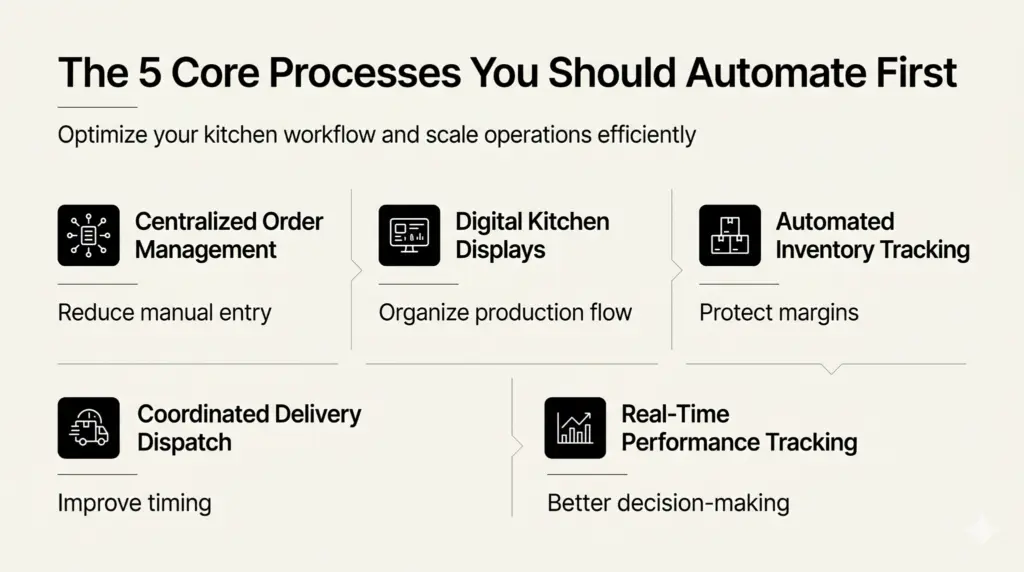
- Centralized order management to reduce manual entry
- Digital kitchen displays to organize production flow
- Automated inventory tracking to protect margins
- Coordinated delivery dispatch to improve timing
- Real-time performance tracking for better decisions
Order management and integration
Managing multiple ordering channels manually can quickly become a source of errors and missed opportunities. When your team needs to re-enter orders from different platforms, delays and inconsistencies become more likely, especially during peak hours.
Automation allows you to integrate all your channels into a single system through POS integration and order management systems.
Every order flows into one place, which reduces the risk of lost tickets and improves processing speed. As a result, your operation becomes more reliable and easier to manage.
Kitchen workflow (KDS and task flow)
A kitchen without a clear workflow often struggles with hidden inefficiencies that slow everything down. Paper tickets can be difficult to manage and easy to misinterpret, which leads to rework and wasted time.
A kitchen display system (KDS) replaces paper with digital screens that organize tasks based on priority and preparation time.
This creates a clearer structure for your team and improves coordination between stations. With better visibility, your kitchen can operate more smoothly and reduce unnecessary errors.
Inventory and supply tracking
Inventory issues often appear at the worst possible moment, especially during peak demand. Running out of key ingredients or over-ordering can directly impact your margins and your ability to serve customers consistently.
Automated inventory tracking gives you a more accurate and real-time view of your stock based on actual sales.
Systems can alert you when items are running low and support better purchasing decisions. This level of control helps you reduce waste, avoid shortages, and maintain a more predictable operation.
Delivery and dispatch coordination
Delays in delivery are one of the fastest ways to impact customer experience and damage your brand reputation.
When dispatch is handled manually, timing becomes inconsistent and coordination between kitchen and drivers becomes more difficult.
Automation helps you create a more synchronized and reliable process:
- Orders are released only when they are ready
- Drivers are assigned based on timing and location
- Preparation and dispatch stay aligned during peak periods
This improves delivery accuracy and reduces waiting time for both your team and your customers. A more coordinated dispatch flow leads to fewer delays, better reviews, and a more predictable operation as your volume grows.
Performance and data tracking
Many restaurants operate without a clear view of their own performance. Decisions are often based on intuition rather than real data, which makes it harder to identify inefficiencies or growth opportunities.
Automation changes this by providing real-time insights into your operation. You can track preparation times, order volume, peak hours, and error rates without relying on manual reports. This allows you to make faster and more informed decisions.
According to McKinsey, AI-driven workforce management can reduce operational costs by 8–12%, improving efficiency and resource allocation in restaurant operations.
What NOT to automate (at least not yet)
Not every process needs automation, and trying to automate everything too early can create unnecessary complexity. The key is to focus on what truly impacts your operation and avoid investing in areas that will not generate meaningful returns.
Processes with low operational impact
Some processes do not directly affect speed, revenue, or customer experience. Automating these tasks may not deliver a meaningful return in the short term.
Prioritization is essential. Focus first on areas that influence order flow, production speed, and consistency. Secondary processes can be optimized later as your operation grows.
Human-dependent tasks
Certain parts of your operation still benefit from human judgment and interaction. Food quality control, final plating decisions, and customer communication often require a level of nuance that automation cannot fully replace.
Balancing efficiency with quality is critical. Automation should support your team, not remove the elements that define your brand experience.
Automation without volume
Automation becomes more valuable as your order volume increases. Without consistent demand, the return on investment may take longer to materialize.
Without sufficient volume, automation can behave more like a fixed cost than a growth driver. As your operation scales, however, these systems become essential to maintaining performance and consistency.
How to prioritize automation in your kitchen
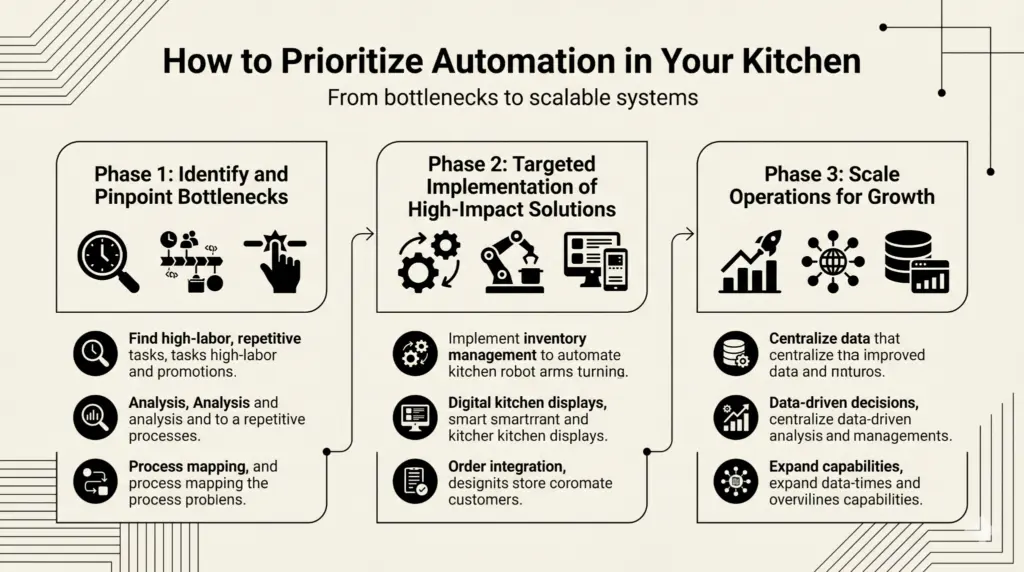
Knowing what to automate is only part of the process. You also need a clear way to prioritize where to start and how to scale your systems over time.
Identify your biggest bottleneck
Start by looking at where your operation slows down. This could be order intake, kitchen coordination, delivery timing, or inventory management.
Ask simple questions. Where do delays happen most often? Where do errors occur? Which step creates the most stress for your team?
Your biggest bottleneck is usually the best place to begin.
Measure impact vs complexity
Not all automation delivers the same value. A simple way to prioritize is to evaluate each opportunity based on impact and complexity.
Processes that offer high impact and low complexity should come first. These are the changes that improve performance quickly without requiring major operational disruption.
More complex systems can be introduced later, once your foundation is stable.
Start small, scale fast
Starting with a few high-impact processes allows you to build momentum and see results early.
As your operation becomes more structured, you can expand your systems and integrate more advanced tools. This step-by-step approach reduces risk and helps your team adapt more easily.
Many operators adopt this model when transitioning to delivery-first environments, where infrastructure and layout are already designed to support streamlined workflows and integrated systems.
The hidden impact of automation on growth
Automation is often seen as an operational improvement, but its impact goes beyond efficiency. When implemented correctly, it becomes a driver of growth.
Restaurants adopting AI and automation technologies report revenue increases in up to 56% of cases, highlighting the direct business impact of these tools.
Faster service increases order capacity
When your kitchen operates faster, you can handle more orders within the same timeframe. This directly increases your revenue potential without requiring additional space or significant increases in labor.
Speed becomes a competitive advantage, especially in delivery-focused markets.
Consistency improves customer experience
Automation helps standardize processes, which leads to more consistent output. Orders are prepared more accurately, timing becomes more predictable, and customers receive the experience they expect.
Consistency tends to translate into better reviews and stronger customer retention over time.
Data enables smarter decisions
Growth is also about making better decisions consistently. According to McKinsey, companies that leverage data and analytics are 1.5 times more likely to outperform their peers in growth and performance.
In a kitchen environment, this means understanding demand patterns, optimizing staffing, and refining your menu based on real performance data.
With automation, you move from reacting to problems to anticipating them.
Is kitchen automation worth it for your business?
The value of kitchen automation depends on your current operation, your growth stage, and your long-term goals. However, most delivery-focused kitchens reach a point where automation becomes a necessary step.
Small restaurants vs large operations
Smaller restaurants can benefit from automation by reducing manual workload and improving organization. Even simple integrations can create immediate improvements in daily operations.
Larger operations, especially those managing multiple channels or brands, rely on automation to maintain consistency and scale efficiently.
Cost vs long-term ROI
Automation requires an upfront investment in systems and integration. However, the long-term gains often come from reduced errors, better labor allocation, and increased order capacity.
Over time, these improvements contribute to stronger margins and a more predictable operation.
When automation becomes essential
There are clear signals that indicate when automation is no longer optional. These include an increase in order volume, the use of multiple sales channels, and the need to scale operations without compromising quality.
At this stage, having the right infrastructure in place becomes critical. Kitchens designed for delivery and equipped to support integrated systems can make this transition more efficient and easier to manage.
Automation is not about replacing people. It’s about unlocking your kitchen’s potential
If your kitchen feels constantly under pressure, automation can help you create structure where there is currently friction. Instead of reacting to problems as they appear, you build a system that supports your team and improves performance over time.
The goal is not to remove people from your operation. It is to give them the tools and environment they need to work more efficiently and consistently.
When your workflows are clear, your data is reliable, and your systems are connected, your kitchen becomes easier to manage and better prepared to grow.
See how your kitchen could run with fewer errors and faster output
If you are dealing with missed orders, delays, or lack of visibility in your operation, it may be time to rethink how your kitchen is structured.
Explore how purpose-built kitchen environments and integrated infrastructure can support automation, improve coordination, and help you scale your operation with more control.
Discover CloudKitchens locations and see how private kitchen spaces designed for delivery can help you build a more efficient and scalable operation.
DISCLAIMER: This information is provided for general informational purposes only and the content does not constitute an endorsement. CloudKitchens does not warrant the accuracy or completeness of any information, text, images/graphics, links, or other content contained within the blog content. We recommend that you consult with financial, legal, and business professionals for advice specific to your situation.