Understanding how the model works separates short-term traction from long-term viability.
The delivery economy continues to expand, but launching a delivery brand and sustaining it are very different challenges. Early momentum often hides inefficiencies that only become visible over time.
Most failures are not caused by the food itself. They are caused by how the operation is structured, how demand is accessed, and how costs are managed in a delivery-first environment.
Building a successful delivery business requires shifting from a product mindset to an operational one.
Read more: Why Your Most Valuable Location Must Not Have Street Access (And How to Lease It)
Most Delivery Brands Don’t Fail at Launch, They Fail Later
While there is no single universal failure point, industry data from Equidam shows that many businesses begin to struggle after their first year, with failure rates accelerating significantly between the second and fifth years.
Additionally, research indicates that startups survive for an average of around 20 months after their last funding round before shutting down, reflecting a critical period where financial pressure and operational complexity converge
This period represents a transition where early momentum fades, operational complexity increases, and financial pressure intensifies.
In delivery-first businesses, this transition tends to happen faster and with greater intensity. Unlike traditional models, delivery operations depend on tight margins, platform commissions, and high coordination across logistics, kitchen operations, and demand variability.
As a result, the same structural pressures identified in startups, rising costs, operational complexity, and the need for consistent demand, become more acute, often surfacing within the first 12 to 24 months of operation.
The illusion of early traction
Early demand is often driven by platform exposure, discounts, or launch curiosity. This can create a misleading sense of validation.
Without consistent repeat orders, this demand is not sustainable. If customer acquisition costs remain high and retention is low, growth becomes dependent on continuous spending rather than organic demand.
Over time, the gap between perceived traction and actual performance becomes clear.
When operational cracks start to show
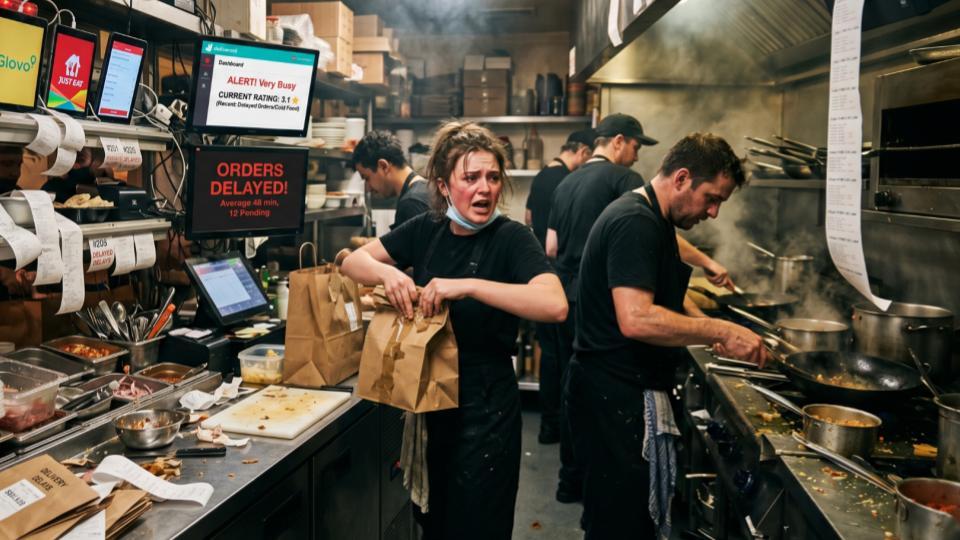
As order volume grows, small inefficiencies become systemic problems. Delays in preparation, packaging inconsistencies, and coordination issues start to affect delivery times.
Customer experience declines quickly in this environment. Lower ratings reduce visibility on delivery apps, which directly impacts order volume.
Without standardized processes, the operation becomes reactive instead of controlled.
The moment costs overtake revenue
As the business matures, costs become more visible and harder to offset. Marketing spend increases to maintain visibility, while platform commissions continue to pressure margins.
If the operation is not optimized, revenue growth does not translate into profitability. At this stage, many brands realize that their cost structure is not sustainable. This is often the point where concepts begin to decline.
The Hidden Reasons Delivery Businesses Fail (That No One Talks About)
Beyond visible challenges, there are structural factors that directly influence performance but are often underestimated.
Demand is not evenly distributed
Delivery performance depends heavily on local demand density. Not all areas generate consistent order volume, even if they appear attractive on the surface.
Operating in low-density zones increases delivery times and reduces order frequency. This impacts both customer satisfaction and kitchen throughput.
Choosing locations based on delivery demand is a critical factor for long-term viability.
Great food doesn’t guarantee repeat orders
In delivery, execution defines the experience. Food quality matters, but consistency, temperature, and presentation on arrival are equally important.
If the product does not travel well, customer satisfaction drops regardless of how good it is when it leaves the kitchen. Repeat business depends on reliability, not just taste.
Marketing dependency becomes a trap
Delivery platforms provide reach, but they also control visibility and customer access. This creates dependency.
As competition increases, acquisition costs rise. Brands that rely only on platforms must continuously invest to maintain volume.
Without alternative channels or retention strategies, margins become increasingly compressed over time.
The Structural Mistakes That Kill Profitability
Many delivery brands struggle because they apply traditional restaurant logic to a delivery-first operation.
Overspending on setup instead of flexibility
High upfront investment in physical spaces limits the ability to adapt. Fixed costs remain constant even when demand fluctuates.
Delivery-first models benefit from lower overhead and the ability to adjust quickly. Flexibility allows operators to test, refine, and scale with less financial pressure.
A rigid setup reduces options when performance does not meet expectations.
Poor menu engineering
Menus that are not designed for delivery create inefficiencies. Complex items slow down preparation and increase the likelihood of errors.
Some dishes do not maintain quality during transport, which affects customer perception and repeat orders. A delivery-optimized menu focuses on speed, consistency, and product integrity from kitchen to customer.
Inefficient kitchen operations
Without a workflow designed for delivery, kitchens become congested during peak hours. This leads to delays, order inaccuracies, and increased waste.
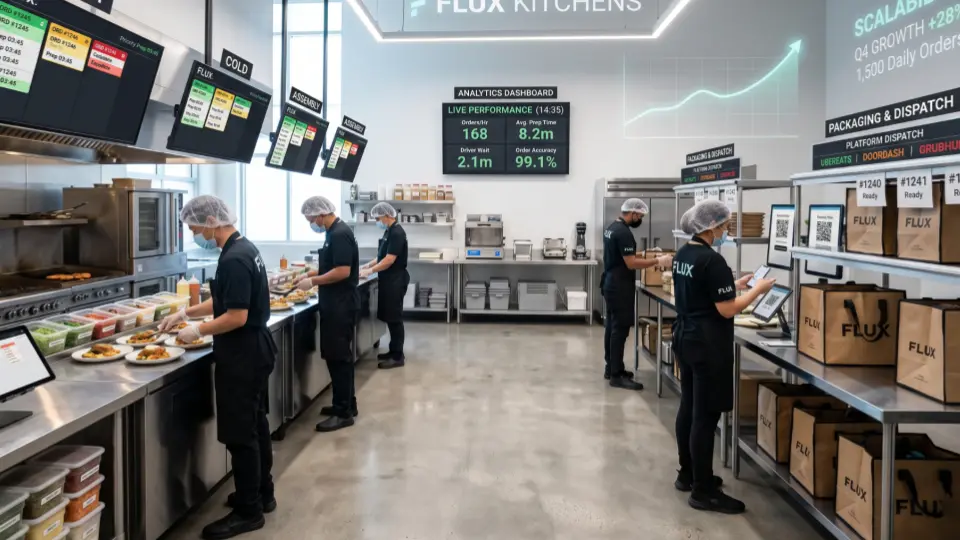
Operational efficiency depends on clear processes and layout optimization. Every step, from prep to pickup, must be aligned with delivery flow. Structured kitchen models reduce friction and improve consistency at scale.
What Successful Delivery Brands Do Differently
Successful brands approach delivery as an operational system, not just a food offering.
They choose locations based on delivery demand, not visibility
Location decisions are driven by data, including order density, customer proximity, and delivery radius. This is supported by industry research from McKinsey & Company, which shows that high population density significantly improves delivery efficiency, reinforcing the importance of positioning kitchens close to demand.
This improves delivery times and increases the likelihood of repeat orders. It also allows better coverage of high-demand areas. Strategic placement directly impacts performance.
They optimize for speed, consistency, and repeatability
Standardization ensures that operations remain stable even as volume increases. Clear processes reduce variability and improve execution.
Speed is also critical. Faster preparation and dispatch improve platform ranking and customer satisfaction. Consistency builds trust, which drives retention.
They build systems, not just menus
Scalable brands rely on structured operations supported by data. Performance is measured, analyzed, and continuously improved.
This allows faster decision-making and more efficient expansion. Instead of reacting to problems, teams operate with clear visibility. Systems create predictability, which is essential for growth.
How to Be the Exception in a Saturated Market
Standing out in delivery requires more than a strong concept. It requires a model designed for efficiency and scale.
- Start with a model designed for delivery: Build specifically for delivery to align operations with demand from the start. Optimize layout, menu, and processes early to reduce inefficiencies and improve performance. Adapting a traditional model often creates friction and limits scalability.
- Reduce fixed costs and increase flexibility: Using private kitchens reduces upfront investment and allows expansion based on demand. This makes it easier to test new areas, adjust strategy, and scale progressively. Greater flexibility improves the ability to respond to market changes.
- Focus on unit economics from day one: Understand the real cost of each order, including ingredients, labor, packaging, and platform fees. Sustainable growth depends on positive unit margins. Without this, higher volume increases losses. Clear cost visibility supports better decisions and long-term stability.
The Problem Isn’t the Idea, It’s the Model Behind It
Most delivery concepts fail because they are built without a structure that supports delivery at scale.
Long-term success depends on aligning operations, costs, and demand from the beginning. When the model is designed for delivery, growth becomes more controlled and sustainable.
Ready to build a delivery brand designed to last? Explore how CloudKitchens’ private kitchen infrastructure supports more efficient operations, stronger location strategy, and scalable growth for delivery-first brands.
DISCLAIMER: This information is provided for general informational purposes only and the content does not constitute an endorsement. CloudKitchens does not warrant the accuracy or completeness of any information, text, images/graphics, links, or other content contained within the blog content. We recommend that you consult with financial, legal, and business professionals for advice specific to your situation.