Discover the best neighborhoods for delivery business in San Francisco to maximize order volume and reach high-frequency customers in 2026.
San Francisco remains one of the most competitive and expensive food markets. For many operators, traditional restaurants come with high fixed costs and limited flexibility.
At the same time, delivery-first models have become a central part of how food brands grow. In this environment, the main risk is not entering the market, but choosing a location that does not support consistent demand.
This guide explores the best neighborhoods for delivery business in San Francisco, breaking down where to open, what type of concept fits each area, and why certain locations perform better than others.
Why location is the single most important decision for a delivery-first brand
In a delivery-first model, location defines how your brand performs inside platforms. This is supported by research analyzing over 24,000 restaurants, which found that location directly impacts delivery time, customer behavior, and overall performance, making spatial strategy a critical factor for success in this research.
A well-chosen location reduces friction across the entire operation. It improves visibility, shortens delivery times, and increases the likelihood of repeat orders.
How delivery radius defines your revenue ceiling
Delivery platforms prioritize proximity. If your kitchen is outside key demand zones, your brand becomes less visible.
This limits how many customers you can reach. It also caps order volume, regardless of marketing efforts. A well-positioned kitchen expands your reachable market and improves conversion inside apps.
The relationship between density and order frequency
Higher density increases order frequency. More customers in a smaller area means more orders per hour and shorter delivery times.
This improves logistics efficiency and supports better use of kitchen capacity. It also helps maintain stable demand throughout the day, not only during peak hours.
Why the wrong neighborhood kills margins
Low-demand areas create pressure on costs. Academic research shows that location, demand distribution, and delivery distance are key drivers of profitability in on-demand delivery models, meaning poor location decisions directly impact margins.
Longer delivery times also affect customer experience. This leads to lower ratings and reduced visibility in apps. Over time, this combination makes profitability harder to sustain.
What makes a neighborhood “high-performance” for delivery in 2026
High-performance neighborhoods combine strong demand, efficient logistics, and consistent digital behavior.
- Population density vs purchasing power: Density drives order volume, while purchasing power influences ticket size. The most efficient neighborhoods combine both, creating a balance that supports healthy margins and consistent order flow.
- Work vs residential demand patterns: Demand varies by area and time of day. Commercial zones concentrate lunch orders during weekdays, while residential neighborhoods drive dinner and weekend demand. Understanding this dynamic helps define menu, staffing, and operating hours more efficiently.
- Accessibility and logistics: Efficient logistics help reduce delivery times and improve order turnover. Kitchens that are easy for drivers to access minimize delays and increase throughput. Even small gains in delivery time can improve customer satisfaction and encourage repeat orders.
- Digital behavior and app usage: Some neighborhoods rely more heavily on delivery apps in their daily routine. These areas typically show higher digital adoption and more frequent ordering behavior, creating a stronger and more predictable demand base for new brands.
These factors create an environment where orders flow consistently and operations can scale with fewer constraints.
The 10 best neighborhoods in San Francisco for delivery-first brands
Each neighborhood presents a different strategic opportunity. Performance depends on how well your concept fits local demand patterns.
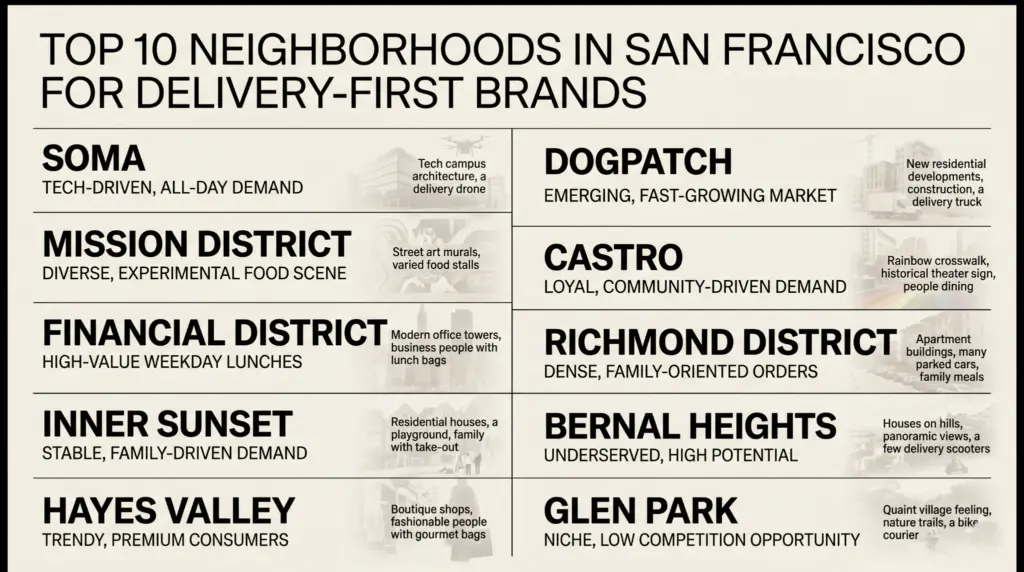
1. SoMa — High-density tech demand with all-day order flow
SoMa is a powerhouse for delivery due to its massive concentration of tech workers and modern residential complexes. The audience here is young, affluent, and highly reliant on digital services for their daily meals and convenience.
This neighborhood offers a strategic opportunity for brands that provide fast, efficient lunch and dinner options. Healthy bowls and premium fast-casual concepts perform exceptionally well here, benefiting from a consistent flow of orders throughout the entire day.
2. Mission District — Cultural diversity and high food experimentation
The Mission District is known for its diverse population and a consumer base that actively seeks out new and bold culinary experiences.
It is a prime location for where to open a delivery restaurant in San Francisco if your concept is unique or fusion-based.
Demand in the Mission is driven by a mix of long-time residents and young professionals who value variety.
Street food concepts and experimental international cuisines find a loyal following here, as the local audience enjoys exploring different flavors via apps.
3. Financial District — High ticket, weekday-driven demand
The Financial District caters primarily to corporate professionals who prioritize speed and quality during the workweek.
While weekend demand is lower, the high average ticket size during weekday lunch hours makes it a lucrative zone for premium brands.
Opportunity in this area lies in providing "premium convenience" for office workers and executives.
Concepts that offer high-end salads, artisanal sandwiches, or sophisticated catering-style meals can capture significant market share during the peak 11 AM to 2 PM window.
4. Inner Sunset — Stable residential demand with predictable volume
Inner Sunset provides a stable environment with a mix of families and students from nearby institutions.
This demographic creates a predictable and consistent daily order volume, making it one of the most reliable best neighborhoods for delivery business in San Francisco.
The best brand fits for this area include comfort food, pizza, and Asian cuisine. These categories align with the family-oriented nature of the neighborhood, where repeat orders are common and brand loyalty is built through consistent quality and value.
Read more: Top NYC neighborhoods for growing your food delivery business
5. Hayes Valley — Premium positioning and trend-driven consumers
Hayes Valley is an affluent neighborhood where consumers are highly influenced by current food trends and premium branding.
The audience here is willing to pay a higher price point for concepts that offer high-quality ingredients and a strong brand identity.
This is an ideal location for high-end delivery concepts that focus on aesthetics and "Instagrammable" food. Operators should prioritize packaging and unique menu items that cater to the sophisticated tastes of this trend-oriented consumer base.
6. Dogpatch — Emerging tech hub with strong growth potential
Dogpatch is rapidly transforming into a major tech and residential hub, offering an early-mover advantage for delivery-first food brand operators.
As new developments continue to rise, the demand for convenient food options is outpacing traditional restaurant supply.
Launching in Dogpatch allows a brand to establish itself as a local favorite before the market becomes oversaturated. The growing population of young professionals provides a perfect foundation for modern, delivery-optimized concepts that value speed and reliability.
7. Castro — Strong local demand and loyal customer base
The Castro is characterized by a strong sense of community and a customer base that rewards brands with high repeat order rates.
Brand identity and community engagement are vital for success in this vibrant and densely populated neighborhood.
Operators in the Castro should focus on building a recognizable brand that resonates with local values. High-quality comfort food and creative dessert concepts often see strong performance due to the neighborhood's active social scene and residential density.
8. Richmond District — High residential density with family demand
The Richmond District offers some of the highest residential density in the city, particularly for families. This creates a high frequency of orders, as busy households often turn to delivery for their nightly dinners and weekend gatherings.
Value-driven concepts that offer family-sized portions or meal bundles are highly successful in this area.
Brands that focus on traditional favorites like Chinese food, Italian, or American classic fare tend to capture the most consistent order volume.
9. Bernal Heights — Growing food destination with underserved demand
Bernal Heights has emerged as a significant food destination, yet it remains underserved by high-quality delivery options.
This gap in the market presents a strategic opportunity for early positioning in a neighborhood with a growing appetite for diverse cuisines.
The audience in Bernal Heights appreciates artisanal and locally-focused brands. By offering unique menu items that aren't available in the immediate vicinity, a virtual restaurant can quickly become the go-to choice for the neighborhood's discerning residents.
10. Glen Park — Small but high-potential neighborhood
Glen Park may be smaller than other districts, but its high-potential demographic and lower competition make it a hidden gem for strategic positioning. The affluent resident base has a high purchasing power but fewer local dining options compared to downtown.
This neighborhood is ideal for a niche brand that wants to dominate a specific category without facing the intense competition of SoMa or the Mission. A focused menu with high-quality execution can capture a significant portion of the local delivery market.
How to match your food concept with the right neighborhood
Performance improves when concept and location are aligned. This reduces friction in acquisition and increases repeat behavior.
- Pricing aligned with local purchasing power
- Menu adapted to demand timing
- Category matched to local preferences
Fast casual vs premium positioning
Pricing should reflect the expectations of the local audience, as different neighborhoods respond to different value perceptions.
Premium areas can support higher margins, but they also require stronger branding and more refined presentation to justify the price point. In more residential zones, accessible pricing and clear value tend to drive better results.
When this alignment is right, conversion improves and customers become less sensitive to price.
Late-night vs daytime brands
Demand timing needs to match your operating hours, otherwise even a strong concept can underperform.
Late-night brands tend to rely on residential density and younger audiences who order outside traditional meal times, while daytime concepts perform better near office clusters, where lunch demand is more concentrated.
Aligning your hours with local demand patterns helps increase efficiency and reduces idle capacity throughout the day.
Health food vs indulgent categories
Food preferences vary across neighborhoods and play a direct role in how well a menu performs.
Some areas show a clear preference for health-focused options and convenience, especially among more time-constrained consumers, while others lean toward indulgent and comfort categories.
Recognizing these patterns allows you to adapt your menu more effectively and build stronger repeat behavior over time.
Testing multiple brands with one kitchen
Running multiple concepts from a single kitchen creates more flexibility and allows for faster validation of different ideas.
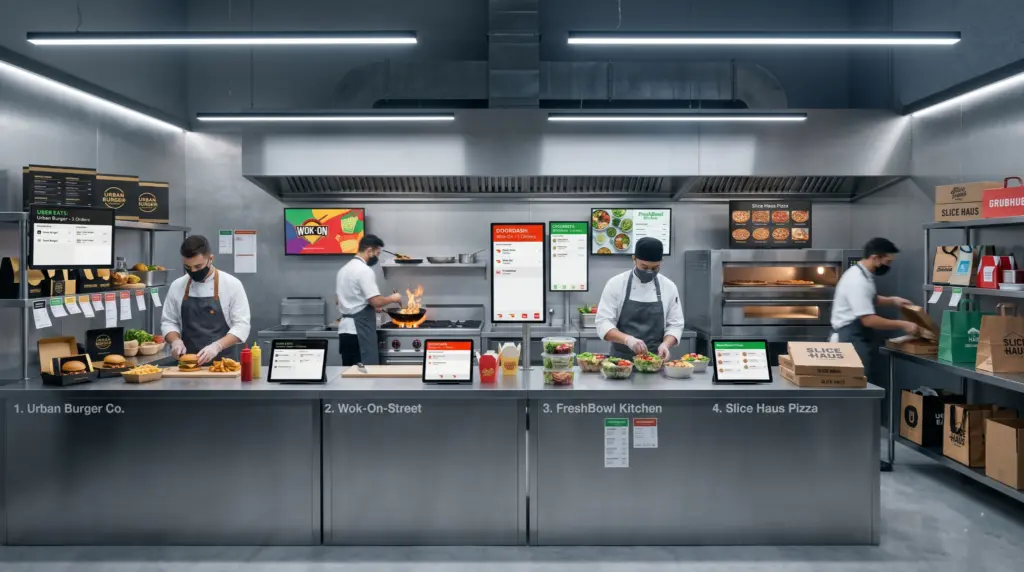
Operators can test categories, adjust menus based on performance data, and refine positioning without committing to a single direction too early.
This approach reduces risk before scaling and also improves kitchen utilization by capturing demand across different time periods.
Read more: How CloudKitchens helps brands expand into new delivery markets in America
Common mistakes when choosing a location
Choosing the right location is a strategic decision, but some common mistakes can limit performance from the start. These errors often seem small, yet they directly impact visibility, demand, and long-term profitability.
- Choosing based on rent only: Lower rent does not necessarily lead to better results. A low-cost location in an area with weak demand often limits order volume and slows growth. Focusing on revenue potential, rather than cost alone, leads to more sustainable performance.
- Ignoring delivery app dynamics: Visibility on delivery platforms is strongly influenced by proximity to demand. Kitchens located closer to high-density areas tend to appear more frequently and attract more orders. Overlooking this dynamic reduces reach and affects overall efficiency.
- Not validating demand before launch: Launching without understanding local demand increases uncertainty and risk. Analyzing customer preferences and existing competition helps identify real opportunities. Validation supports stronger early performance and more informed decisions.
- Overestimating brand awareness: New brands rely heavily on platform visibility to gain traction. Without the right location, even strong concepts may struggle to be discovered. Positioning your kitchen near active demand helps accelerate growth and build consistent order flow.
How to launch faster in high-demand neighborhoods
Entering the right neighborhood quickly can influence how a delivery brand performs from the start. Speed, when combined with structure, allows operators to capture demand earlier, learn faster, and scale with more control.
Plug-and-play kitchens
Private kitchens designed for delivery reduce the complexity of setup and eliminate many of the steps required in traditional openings.
The infrastructure is already aligned with delivery operations, which allows teams to focus on execution rather than construction. This creates a more efficient path to entering competitive, high-demand areas.
Speed to market advantage
Launching earlier increases the chances of capturing demand before the market becomes saturated. It also allows operators to start collecting performance data sooner, which supports faster and more informed decisions.
With quicker feedback loops, brands can adapt their strategy and improve operations while competitors are still in earlier stages.
Testing menus before scaling
Menus can be refined using real order data, which improves alignment with customer preferences and reduces waste.
Instead of relying on assumptions, operators can identify what performs best and adjust accordingly. Testing in high-demand neighborhoods generates more consistent data, making it easier to validate what should be scaled.
Multi-location expansion strategy
Expanding into neighborhoods with similar demand patterns increases operational efficiency and market coverage.
A broader presence improves delivery radius and allows the brand to reach more customers without compromising speed. When expansion follows a structured approach, growth becomes more predictable and easier to manage.
Build in the Right Location with CloudKitchens
The right neighborhood plays a direct role in how your brand performs and scales over time. In a market like San Francisco, location determines how efficiently you reach demand and how consistently you can operate.
CloudKitchens supports this decision by offering private kitchen infrastructure in strategically selected, high-demand areas. This allows operators to position their brands closer to active customers while operating in spaces designed specifically for delivery.
By focusing on data, demand density, and purchasing power, you can make more precise decisions from the start. With the right location and a structured setup, it becomes easier to build a delivery operation that is consistent, flexible, and ready to scale.
Explore CloudKitchens locations and take the next step toward a more efficient and scalable delivery model.
DISCLAIMER: This information is provided for general informational purposes only and the content does not constitute an endorsement. CloudKitchens does not warrant the accuracy or completeness of any information, text, images/graphics, links, or other content contained within the blog content. We recommend that you consult with financial, legal, and business professionals for advice specific to your situation.