Why some delivery ecosystems quietly outperform major cities — and what restaurant operators can learn from them.
Delivery-first restaurants have expanded rapidly in recent years, reshaping how food brands reach customers and scale operations.
Ghost kitchens and commercial kitchen models have become central to this shift, allowing operators to focus on production while relying on digital channels for demand generation.
Despite this growth, profitability is far from uniform. Some delivery businesses struggle to sustain margins in highly competitive markets, while others achieve more consistent results in less obvious locations.
This contrast highlights a broader question for the industry: why do certain hubs, such as those emerging in Minneapolis, generate stronger delivery profit while more saturated markets continue to face operational pressure?
What “delivery profit” actually means in modern food operations
Understanding delivery profit requires looking beyond revenue and focusing on how efficiently a business converts orders into margin. In delivery-first models, operational structure plays a central role in determining financial performance.
Delivery profit vs traditional restaurant profit
Traditional restaurants operate with a cost structure heavily influenced by front-of-house labor and high-visibility real estate. Delivery-first operations, by contrast, reduce these variables and concentrate resources on kitchen production and order fulfillment.
This structural difference has a direct impact on margins. Ghost kitchens can achieve higher profitability than traditional restaurants due to lower overhead, reduced staffing requirements, and more flexible space utilization.
The unit economics behind delivery kitchens
Delivery profit is shaped by a set of core variables that must be continuously managed. These include average order value, ingredient costs, labor efficiency, and platform commissions.
Delivery aggregators typically charge between 15% and 30% per order, according to Qamarero. These fees significantly influence pricing strategies and require operators to carefully balance cost structure and menu design to maintain sustainable margins.
Why scale and density drive margin
Scale improves efficiency by allowing kitchens to optimize ingredient usage and reduce waste. At the same time, density increases the number of orders within a limited area, improving delivery speed and reducing idle time for drivers.
Multi-brand kitchens play an important role in this dynamic. By operating multiple concepts within the same infrastructure, operators can increase kitchen utilization and distribute fixed costs across a larger volume of orders, strengthening overall delivery profitability.
Why geography plays a hidden role in delivery profitability
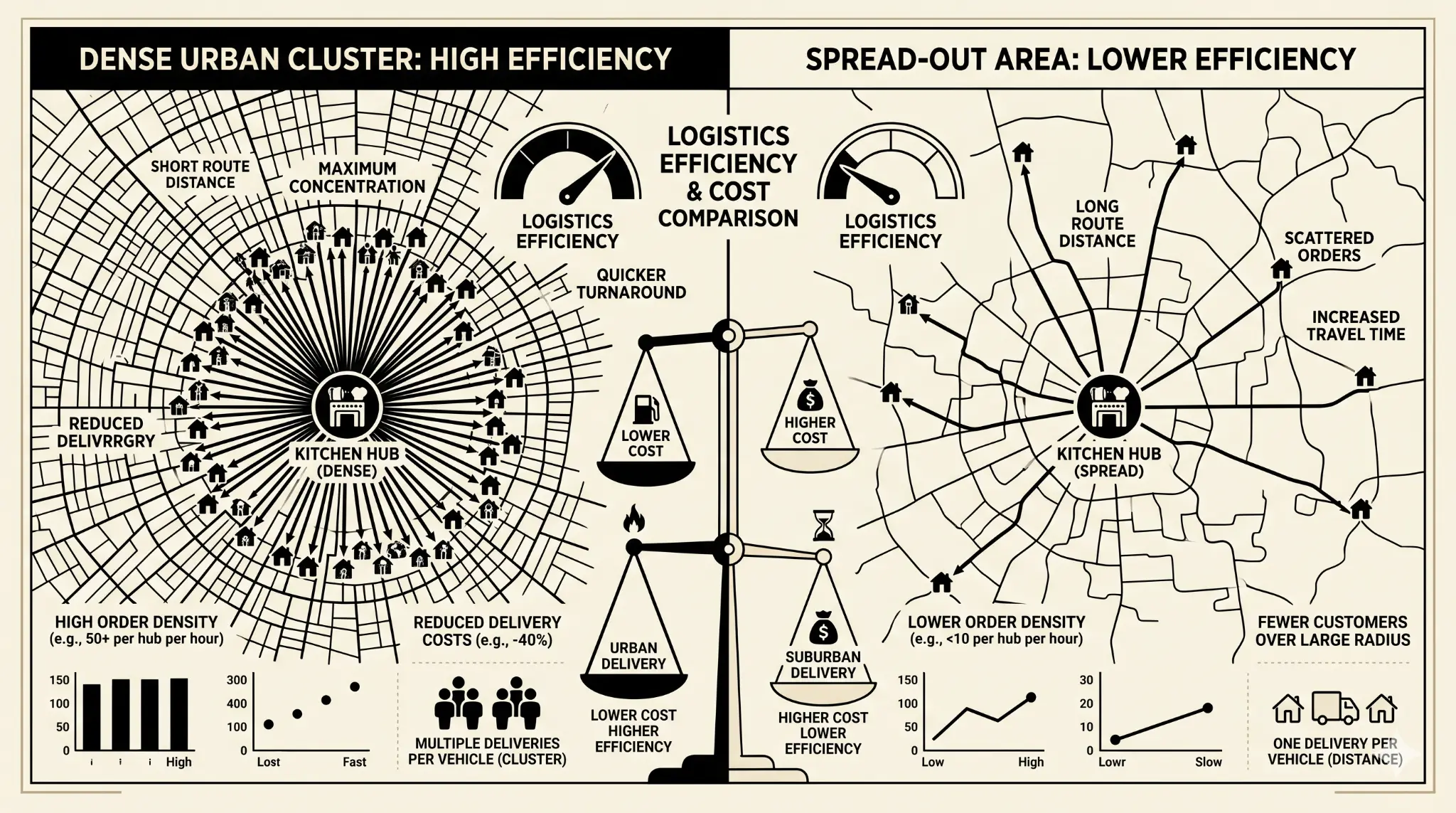
Location influences nearly every aspect of delivery performance, from logistics efficiency to cost structure. The same operational model can produce very different results depending on the surrounding environment.
Delivery radius and logistics efficiency
Shorter delivery distances improve both speed and food quality. They also allow drivers to complete more orders within a given time frame, increasing overall system efficiency.
Higher order density within a compact radius creates a more predictable and efficient delivery cycle. This directly supports stronger delivery kitchen economics and more consistent customer experience.
Mid-sized cities vs saturated megacities
Large metropolitan areas often present high barriers to profitability due to elevated rent, intense competition, and complex logistics. In contrast, mid-sized cities tend to offer a more balanced operating environment.
Lower occupancy costs and less saturated demand allow operators to establish a stronger position more quickly. At the same time, growing consumer adoption of delivery services in these regions creates favorable conditions for expansion.
Urban clusters that concentrate demand
Clusters such as food halls and kitchen hubs concentrate both production and demand within specific areas. This reduces delivery distances and simplifies logistics coordination.
By bringing multiple brands together in a single location, these hubs create a more efficient delivery ecosystem, improving both operational performance and revenue potential.
The food hall advantage: why hubs outperform isolated kitchens
Food hall environments introduce structural advantages that are difficult to replicate in standalone operations. These advantages are directly linked to cost efficiency and demand concentration.
Centralized infrastructure lowers operational costs
Operating within a hub allows restaurants to share essential infrastructure such as utilities, maintenance, and support services. This reduces the initial investment required and lowers ongoing operational expenses.
In addition, collective visibility and brand proximity can enhance customer awareness, contributing to higher overall demand across the ecosystem.
Multi-brand synergy increases kitchen utilization
Multi-brand operations enable kitchens to remain active throughout different periods of the day. By offering varied concepts from the same space, operators can capture multiple demand segments without increasing fixed costs.
Data from Gitnux indicates that ghost kitchens leveraging multi-brand strategies can significantly increase revenue potential by maximizing asset utilization and reducing downtime.
Higher average order value in food hall ecosystems
Food hall environments encourage cross-brand ordering, allowing customers to combine items from different menus in a single purchase. This variety often leads to larger orders and higher average ticket sizes.
Bundled delivery also improves cost efficiency per order, benefiting both operators and consumers while reinforcing the overall delivery profit of the system.
Case study: Minneapolis and the rise of profitable Midwest delivery hubs
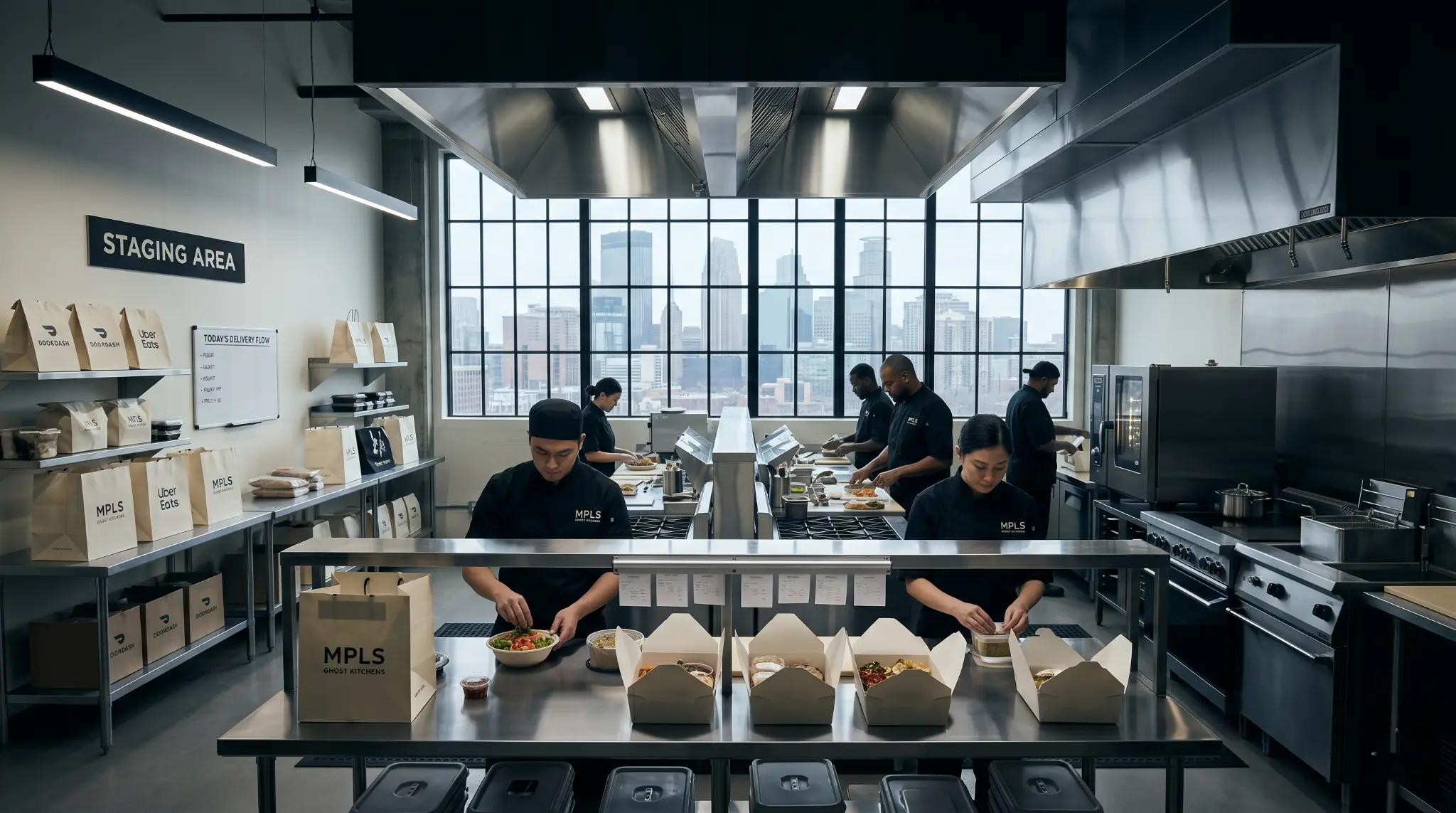
Midwest cities such as Minneapolis have emerged as strong performers within the delivery landscape, offering a combination of favorable cost structures and growing demand.
Why the Midwest offers strong delivery economics
Lower operating costs, combined with stable consumer demand, create an environment where delivery businesses can achieve more consistent margins.
Compared to coastal markets, competition is often less intense, allowing new entrants to scale more efficiently.
How hubs like Currie Food Hall create delivery ecosystems
Locations such as Currie Food Hall illustrate how clustering restaurants within a single hub can generate dense and predictable delivery demand. These environments support multiple brands operating simultaneously, improving both efficiency and order volume.
Integration with delivery platforms further strengthens this ecosystem, enabling smoother coordination between order intake, preparation, and dispatch.
Lessons operators can apply in other cities
Operators can apply these insights by focusing on market selection, prioritizing areas with balanced cost structures and growing demand. Building multi-brand concepts and leveraging centralized infrastructure are also key strategies for improving performance.
These approaches allow restaurants to scale more efficiently while maintaining control over operational complexity.
How operators can increase delivery profit in private kitchen hubs
Improving delivery profit requires a combination of operational discipline and strategic positioning. In private kitchen environments, these gains can be amplified through coordinated execution.
Designing delivery-optimized menus
Menus should be designed with delivery in mind, prioritizing items that maintain quality during transport and can be prepared efficiently. Packaging also plays a critical role in preserving the customer experience.
Simplified menus reduce preparation time and improve consistency, supporting a more efficient kitchen workflow.
Building multi-brand restaurant concepts
Operating multiple brands from a single kitchen allows for ingredient sharing and better resource utilization. This reduces waste and increases flexibility in responding to demand across different dayparts.
Cross-brand strategies also expand market reach without requiring additional physical locations.
Reducing platform dependency
While delivery platforms provide access to demand, reliance on them can impact margins. Developing direct ordering channels helps operators retain a larger share of revenue and build stronger customer relationships.
Strategies focused on direct ordering and customer retention can reduce dependency on aggregators and improve long-term profitability.
The future of delivery profit belongs to smart hubs
Delivery profitability is no longer defined only by menu or brand strength. It is increasingly shaped by geography, infrastructure, and the structure of local delivery ecosystems.
Hubs that combine strategic location, infrastructure, and operational efficiency are redefining how restaurants approach growth in the delivery economy.
Ready to build a delivery concept with stronger margins?
Discover CloudKitchens locations and see how strategically positioned and private kitchen hubs can help improve delivery profitability.
DISCLAIMER: This information is provided for general informational purposes only and the content does not constitute an endorsement. CloudKitchens does not warrant the accuracy or completeness of any information, text, images/graphics, links, or other content contained within the blog content. We recommend that you consult with financial, legal, and business professionals for advice specific to your situation.