Optimize delivery processes by separating workflows, automating tasks, and eliminating inefficiencies in kitchen operations.
Delivery processes represent the core operational structure of any successful food service business. When these workflows are unorganized, the kitchen faces constant friction, leading to delayed orders and reduced food quality.
Implementing a strategic food delivery workflow allows managers to identify hidden costs and improve speed. This guide explores how to redesign your operations using a professional framework for maximum efficiency.
Why Inefficient Processes Hurt Delivery Operations
Operational inefficiencies often start as small coordination gaps but quickly affect the entire operation. In delivery kitchen operations, even minor delays impact preparation time, order accuracy, and delivery speed.
According to the National Restaurant Association, off-premise orders now make up nearly 60% of foodservice occasions, highlighting that delivery and takeout represent a large share of restaurant activity.
Common issues include bottlenecks during peak hours, duplicated tasks across stations, and poor synchronization between kitchen workflow and delivery dispatch.
These factors reduce restaurant operational efficiency and make it harder to maintain consistency as order volume grows.
Automation helps address these challenges. It reduces operational errors and improves workflow efficiency by minimizing manual steps and standardizing information flow.
Without a structured approach to delivery processes, kitchens become reactive, increasing team pressure and limiting the consistency of the food service workflow.
Which Food Processes Should Be Separated
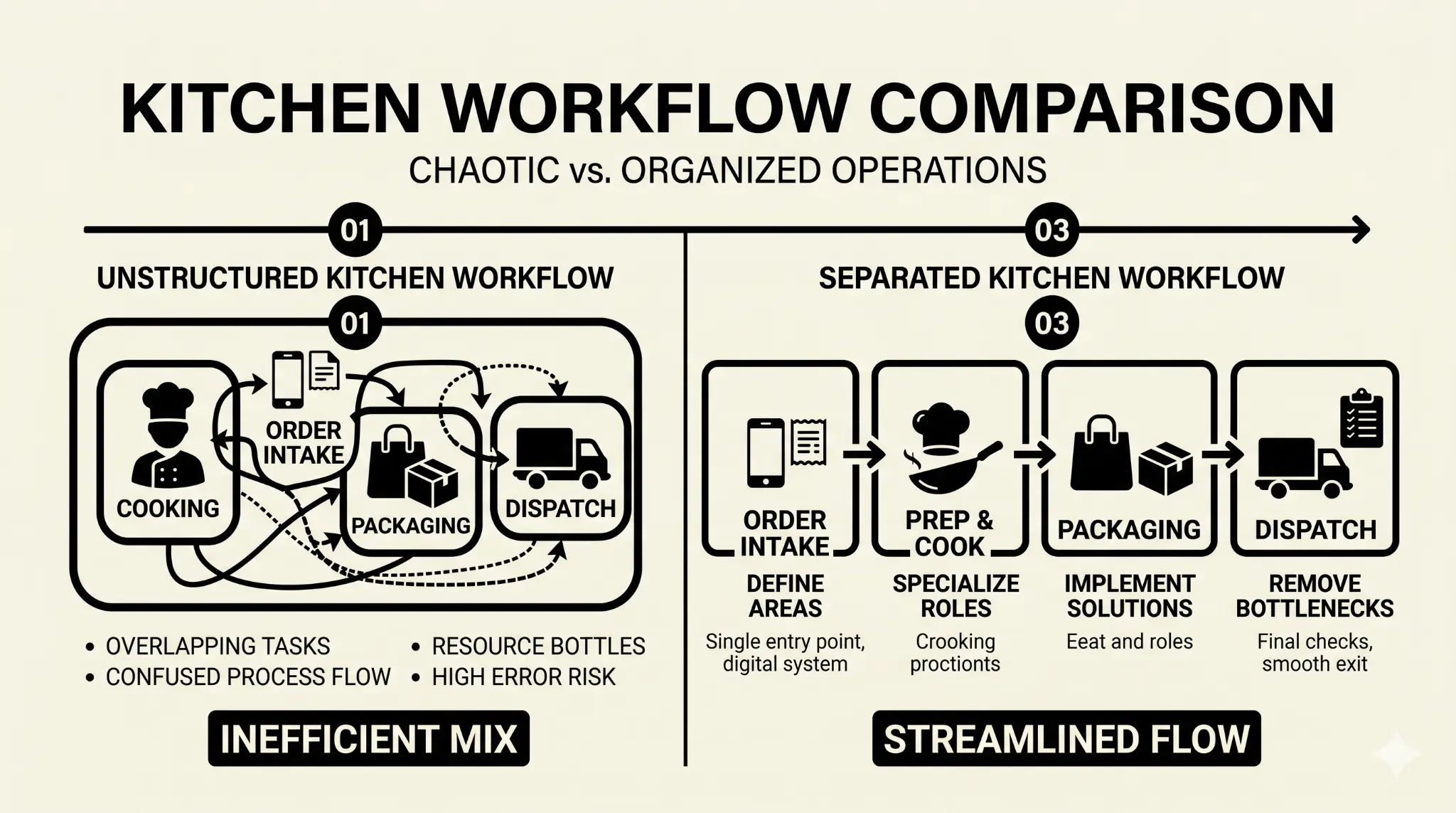
Separating workflows allows kitchens to operate with greater clarity and control, reducing overlaps and improving execution across different stages of production.
This approach is particularly relevant in delivery kitchen operations, where speed and coordination directly affect outcomes.
Production vs Assembly
Combining cooking, plating, and packaging within the same workflow often leads to congestion and inefficiency, especially during high-demand periods.
When these functions are separated, each stage can be optimized independently, allowing teams to focus on specific tasks without interruption.
Production should remain dedicated to food preparation, ensuring consistency and timing, while assembly should handle plating and packaging with a focus on presentation and order accuracy. This separation improves the overall kitchen production workflow and reduces delays caused by task switching.
Order Intake vs Kitchen Operations
Order intake should be managed independently from kitchen operations to prevent constant interruptions during food preparation. When orders are manually communicated to the kitchen, it increases the risk of errors and slows down production.
Digital ordering systems and centralized order routing allow orders to be processed, organized, and prioritized before reaching the kitchen.
This creates a more stable and predictable kitchen workflow, improving coordination and reducing pressure on staff during peak hours.
Delivery Dispatch vs Food Preparation
Delivery dispatch requires a different type of coordination than food preparation, as it involves logistics, timing, and external variables such as traffic and driver availability.
When dispatch is handled within the kitchen workflow, it can create confusion and disrupt production.
Separating these functions improves delivery logistics workflow and allows each team to operate with greater focus.
Which Delivery Processes Should Be Automated
Automation plays a central role in improving consistency and scalability in delivery kitchen operations. By reducing manual tasks, kitchens can operate with greater precision and respond more effectively to fluctuations in demand.
Order Management and Routing
Manual order handling increases the likelihood of errors and slows down the entire process, especially when orders come from multiple channels.
Automating order management allows systems to receive, organize, and route orders directly to the appropriate kitchen stations.
This creates a more efficient restaurant process management structure and supports smoother food delivery workflow execution.
Inventory Monitoring and Supply Management
Inventory management is a critical component of kitchen workflow optimization, yet it is often handled manually in many operations. This increases the risk of stock discrepancies, waste, and last-minute shortages.
Automation tools can track inventory levels in real time, generate alerts when stock is low, and integrate with suppliers to streamline replenishment.
Automating inventory management helps reduce waste and improves overall operational control, contributing to better restaurant operational efficiency.
Delivery Dispatch and Driver Coordination
Coordinating deliveries manually can be complex, particularly when managing multiple drivers and high order volumes.
Automation simplifies this process by assigning deliveries, optimizing routes, and providing real-time tracking.
Automated systems are highly effective in coordinating order status and delivery dispatch. This separation allows the kitchen to signal when an order is ready without manual communication, which significantly reduces the probability of hand-off errors.
Which Processes Should Be Eliminated
While some processes can be improved through optimization, others create unnecessary complexity and should be removed entirely. Eliminating these inefficiencies is essential for maintaining a streamlined operation.
Manual Order Re-Entry
Re-entering orders manually across different systems is a common issue in restaurant delivery operations. This practice not only consumes time but also increases the risk of inconsistencies between platforms.
Removing manual order re-entry through system integration improves accuracy and reduces delays, making delivery processes more reliable.
Fragmented Communication
Many kitchens receive orders through multiple channels, including messaging apps, phone calls, delivery platforms, and POS systems.
When these channels are not integrated, it becomes difficult to maintain a clear and consistent flow of information.
This fragmentation leads to confusion, missed orders, and operational bottlenecks. Consolidating communication into a unified system is essential for improving coordination and maintaining an efficient food service workflow.
Duplicate Preparation Steps
Duplicate tasks often arise from unclear workflows or inefficient kitchen layouts, leading to multiple stations performing the same actions unnecessarily. This not only slows down production but also increases labor costs.
Eliminating redundant steps helps streamline the kitchen workflow and ensures that each stage of production adds clear value to the process.
Read more: What Makes a Food Processing Kitchen Ready for Compliance and Scale
How High-Performance Delivery Kitchens Design Their Workflows
High-performing kitchens are structured around efficiency, with workflows designed to minimize friction and maximize output. This approach allows them to handle higher order volumes without compromising quality.
Single-Flow Production Design
A single-flow production model organizes tasks in a linear sequence, ensuring that each step follows logically from the previous one. This reduces movement within the kitchen and improves overall coordination.
As a result, delivery kitchen operations become more predictable and easier to manage, particularly during peak periods.
Centralized Order Management
Centralizing order management provides full visibility over incoming orders, allowing teams to prioritize tasks and allocate resources more effectively. This approach simplifies coordination and reduces the risk of errors.
It also strengthens delivery process optimization by ensuring that all orders follow the same structured path from intake to delivery.
Production Zones
Dividing the kitchen into dedicated production zones allows teams to specialize in specific tasks, such as preparation, cooking, assembly, and packaging. This improves efficiency by reducing overlap and minimizing unnecessary movement.
Structured zones support better kitchen workflow organization and contribute to more consistent execution across all stages of the operation.
See how modern kitchen infrastructure enables optimized delivery processes.
A Simple Framework to Optimize Delivery Processes
To achieve long-term success, operators should follow a clear framework for continuous improvement. The "Separate, Automate, Eliminate" model provides a structured approach to refining any restaurant process management strategy effectively.
- Separate functions to reduce confusion
- Automate repetitive tasks to save time
- Eliminate waste to improve profitability
Separate
Separating workflows by function allows each stage of the process to operate independently, reducing interference and improving efficiency. This creates a more organized and scalable operational structure.
Automate
Automation reduces the need for manual intervention in repetitive tasks, improving accuracy and consistency while allowing teams to focus on higher-value activities within the food preparation workflow.
Eliminate
Eliminating unnecessary steps simplifies operations and reduces complexity, making it easier to maintain high levels of restaurant operational efficiency over time.
Rethinking Delivery Operations Starts With Process Design
Inefficient processes limit scalability and make it difficult to maintain consistent performance. In contrast, well-structured delivery processes improve coordination, reduce delays, and support sustainable growth.
Separating workflows, automating repetitive tasks, and eliminating inefficiencies are essential steps for building more efficient and resilient delivery kitchen operations.
Build Delivery Operations That Scale
Modern delivery kitchens are designed around structured and optimized workflows.
By improving kitchen workflow, automating logistics, and refining operational processes, operators can build delivery brands that are better equipped to scale and adapt to changing demand.
Explore CloudKitchens locations and see how purpose-built kitchen infrastructure supports more efficient, scalable delivery operations.
DISCLAIMER: This information is provided for general informational purposes only and the content does not constitute an endorsement. CloudKitchens does not warrant the accuracy or completeness of any information, text, images/graphics, links, or other content contained within the blog content. We recommend that you consult with financial, legal, and business professionals for advice specific to your situation.