How zone and time-based pricing can boost profit, reduce churn, and balance cost-efficiency in urban delivery.
Delivery customers often notice that delivery fees vary depending on where they live. In competitive urban markets, this can quickly become a source of frustration if pricing appears inconsistent or difficult to understand.
At the same time, delivery operators face a different challenge. Costs vary significantly depending on distance, traffic, and delivery time. A single flat fee rarely reflects the real cost of fulfilling an order.
This is where delivery pricing strategies based on geographic zones and delivery time windows become valuable. By structuring fees according to realistic delivery conditions, restaurants and delivery operators can improve profitability while maintaining transparency for customers.
One particularly effective approach is 15-minute zone pricing. This model aligns delivery fees with operational efficiency by defining geographic zones that can be served within short delivery windows. When implemented well, it supports fair pricing, faster delivery, and better customer experience.
Read more: Mastering demand management: Strategies for handling peak delivery periods
What is Zone Pricing Applied to Urban Delivery
Zone pricing is a structured delivery pricing strategy where fixed fees are assigned to predefined geographic areas based on the average cost of serving those locations.
Instead of charging every customer the same amount, businesses divide their service area into zones that reflect realistic delivery conditions.
According to Statista, more than 50% of consumers worldwide expect online food delivery to arrive in 30 minutes or less, reflecting the increasing pressure on delivery operators to optimize logistics and delivery zones.
In delivery logistics, this method helps operators align pricing with operational effort. Areas closer to the kitchen may have lower fees, while zones that require longer travel distances may carry higher charges.
Delivery fees should reflect operational variables such as distance, time, and transportation costs.
Zone pricing differs from other models used in urban delivery pricing models:
- Flat pricing applies the same delivery fee everywhere.
- Distance-based pricing calculates fees according to exact travel distance.
- Zone-based pricing groups customers into geographic areas with predictable delivery costs.
For delivery operations in dense cities, zone-based pricing often provides a practical balance between simplicity and accuracy.
How Zone Pricing Reduces Costs and Improves Predictability
One of the main advantages of delivery zone pricing is operational predictability. When operators know the approximate cost of serving each geographic zone, they can price delivery more consistently.
Consider a hypothetical delivery kitchen serving three zones:
- Zone A: nearby neighborhoods with short travel times.
- Zone B: medium-distance areas with moderate traffic.
- Zone C: outer neighborhoods requiring longer travel.
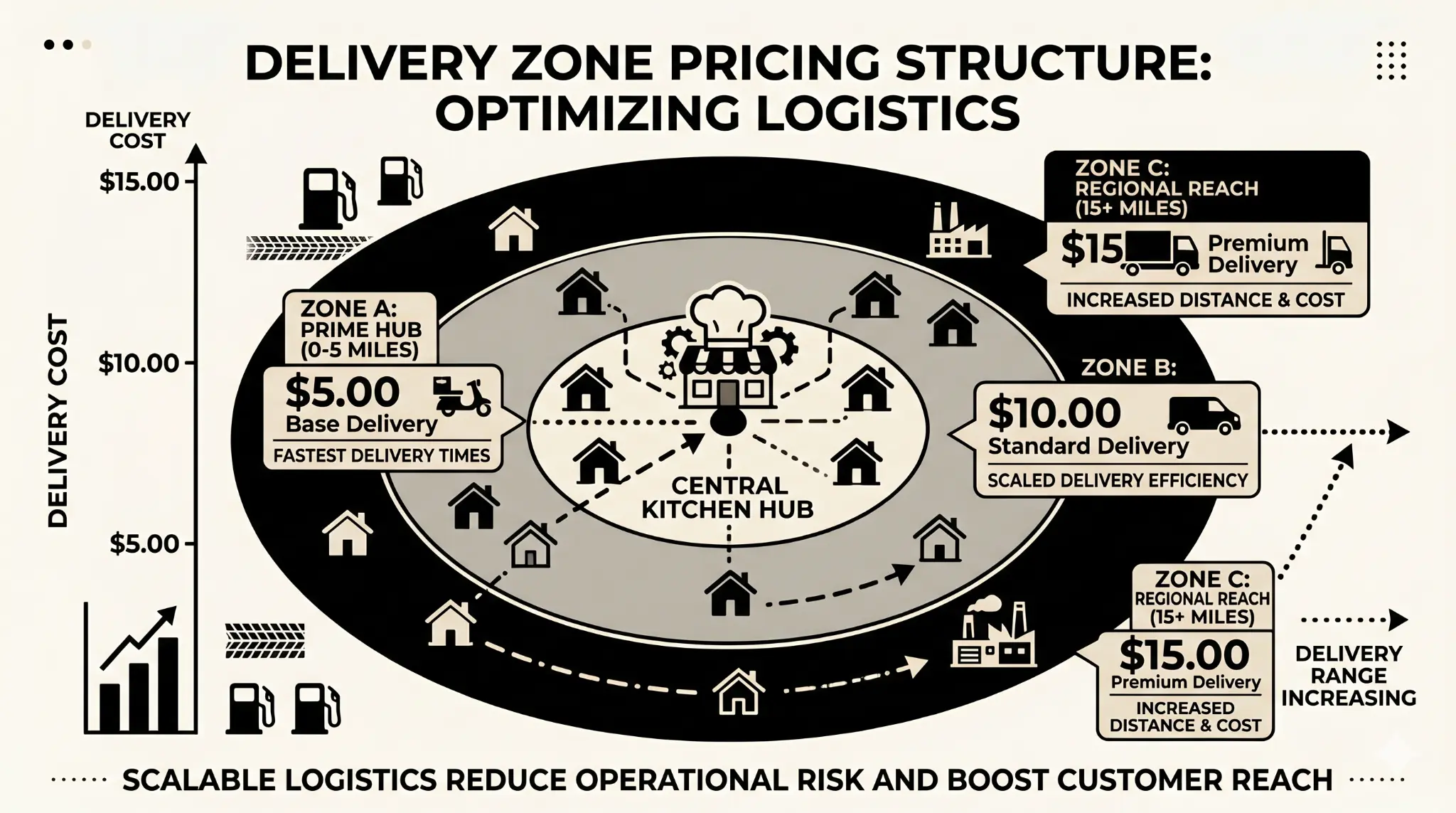
If the delivery fee is identical for all areas, orders from distant zones may become unprofitable. Zone pricing reduces this risk by aligning fees with the cost to serve delivery in each area.
It also simplifies logistics planning. Drivers can focus on specific geographic clusters, which supports more efficient routing and better delivery time estimates.
Why Markets Like Sacramento and San Francisco Require Smart Pricing
Urban markets create unique challenges for delivery pricing strategies. Cities like Sacramento and San Francisco combine high demand with complex traffic patterns and varying population density.
In dense urban cores, deliveries can often be completed quickly due to proximity between customers and kitchens. In suburban zones, travel time increases due to longer distances or lower driver availability.
Competition also plays a role. Delivery platforms and restaurants compete for customers who expect both fast service and reasonable delivery fees.
For these reasons, geographic pricing in delivery becomes essential. Pricing structures must reflect differences between downtown neighborhoods, residential districts, and outer delivery zones.
Without this adjustment, delivery operators may face rising costs or declining conversion rates.
Read more: How CloudKitchens helps brands expand into new delivery markets in America
Zone Pricing vs Dynamic Pricing: When to Use Each
Zone pricing establishes fixed delivery fees for predefined geographic areas. This provides consistency for both operators and customers.
Dynamic delivery pricing, on the other hand, adjusts fees based on demand, time of day, or operational conditions, allowing prices to fluctuate according to real-time demand or resource availability.
These two strategies are not mutually exclusive and can be combined to create a more flexible and efficient pricing model.
A common smart pricing logistics approach combines both models:
- Zone pricing defines the geographic baseline.
- Dynamic pricing adjusts fees during peak demand periods.
This hybrid structure improves delivery cost optimization while maintaining transparency in the overall pricing model.
What 15-Minute Zone Pricing Means and How It Works
The concept of 15-minute zone pricing focuses on aligning pricing with delivery speed. Instead of defining zones only by distance, this model organizes service areas according to realistic delivery times.
According to McKinsey, delivery speed is one of the most important drivers of customer satisfaction, with around 60% of consumers citing it as a key factor when evaluating delivery services.
The goal is simple: define zones that allow most orders to arrive within a short and predictable timeframe.
Clear Definition of 15-Minute Pricing
In a 15-minute pricing model, the primary delivery zone is defined by locations that can typically be served within approximately fifteen minutes.
Customers within this area often receive the lowest delivery fee. The short travel time improves delivery reliability and customer satisfaction.
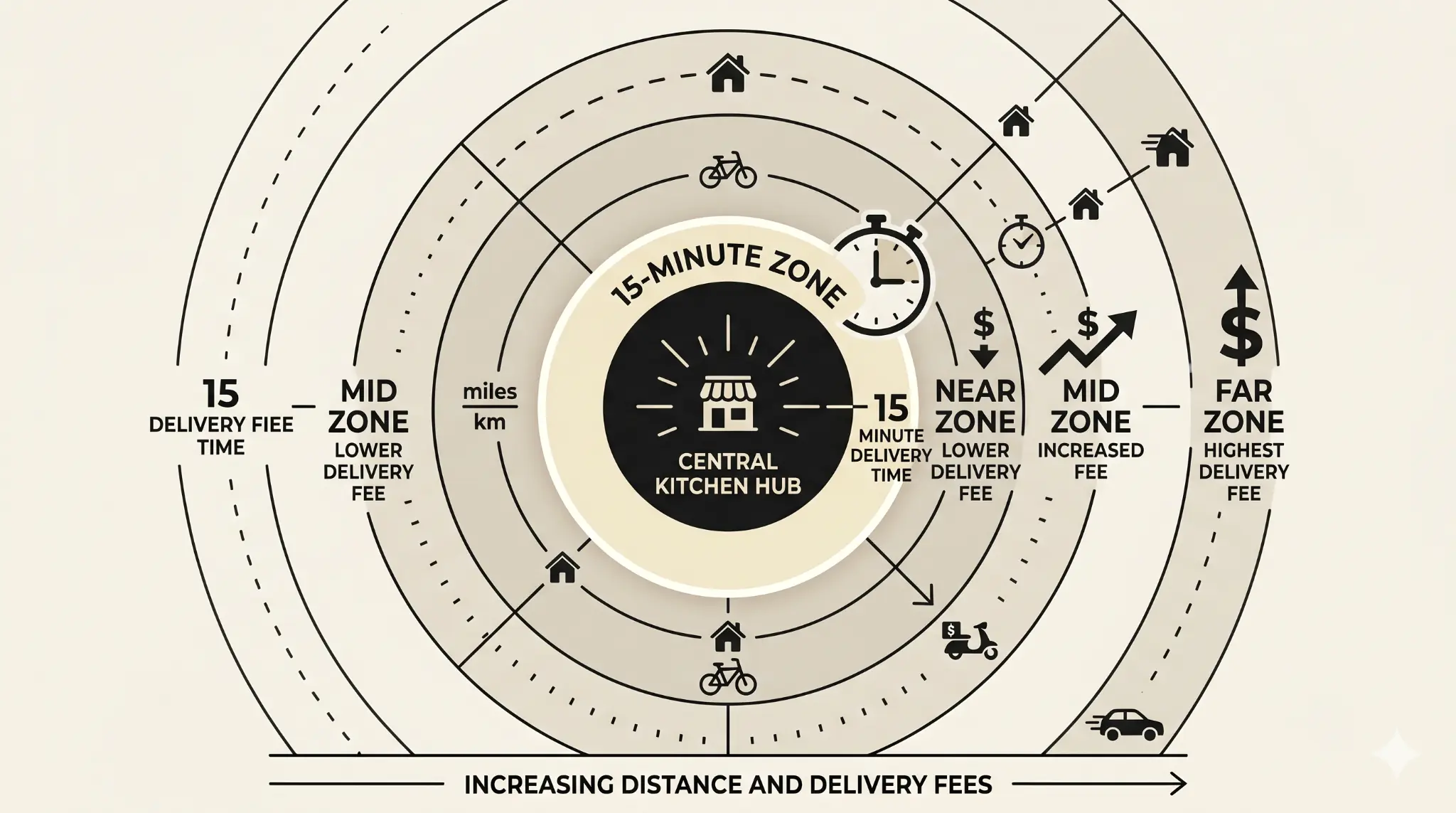
Additional zones may extend beyond this area with adjusted pricing. These distance-based delivery fees reflect the increased operational effort required to complete longer deliveries.
From a customer perspective, the structure is simple:
- Closer customers pay lower fees
- Farther customers pay slightly higher fees
- Delivery expectations remain transparent
This approach supports both hyperlocal pricing delivery and faster fulfillment.
Tactical Models for Quantifying Time-Based Zones
Operators can estimate delivery zones by analyzing travel time, traffic patterns, and average order preparation time.
A simplified model might divide zones like this:
- Zone 1: deliveries typically completed within 15 minutes.
- Zone 2: deliveries requiring moderate travel time.
- Zone 3: longer delivery routes.
By structuring delivery time charges around these zones, operators can maintain profitability while keeping pricing understandable.
Tech Tools and Automation
Modern delivery operations rely on software tools that optimize routes and delivery assignments. These systems analyze driver location, traffic conditions, and delivery distance to estimate travel times.
Routing platforms and logistics tools help operators manage dynamic pricing delivery models by combining geographic zones with real-time data.
Automation also supports better market-based pricing delivery, as operators can adjust fees according to operational conditions without manually recalculating every order.
Practical Implementation in Sacramento and San Francisco with CloudKitchens
Urban delivery pricing works best when it is supported by operational infrastructure. In cities like Sacramento and San Francisco, the location of production kitchens plays a major role in determining delivery time and cost.
This is where CloudKitchens’ network of commercial kitchen locations can support efficient delivery strategies.
How to Collect Delivery Data and Segment Zones Using CloudKitchens Insights
Effective delivery pricing strategy begins with operational data. Delivery operators can analyze order patterns to identify where customers are located and how long deliveries typically take.
Useful data points include:
- Delivery addresses;
- Average delivery time;
- Driver travel distance;
- Cost per delivery route.
CloudKitchens’ network of kitchen locations helps reduce delivery distance by positioning kitchens closer to customers. Strategically located kitchens allow restaurants to reach more neighborhoods while maintaining efficient delivery times.
With this information, operators can define optimized zones that reflect realistic delivery conditions.
How to Communicate Pricing to Customers
Pricing transparency is essential for maintaining customer trust.
Customers respond more positively when delivery fees are clearly presented during checkout rather than appearing as unexpected charges later in the order process.
Displaying delivery fees by zip code or zone helps customers understand how zone-based delivery fees are calculated.
This transparent structure also reduces cart abandonment because customers know the full cost before placing an order.
Continuous Optimization and A/B Testing
Delivery pricing strategies should evolve over time. Testing different pricing structures allows operators to identify which models balance profitability and customer demand.
A simple optimization framework includes:
- Testing different zone boundaries;
- Adjusting delivery fees for specific zones;
- Measuring conversion rates and average order value;
- Monitoring customer retention.
Data analysis helps refine pricing strategy delivery zones while maintaining fair pricing for customers.
Over time, these adjustments support more efficient operations and stronger margins.
15-Minute Zone Pricing: Your Competitive Advantage in Urban Markets with CloudKitchens
Urban delivery markets reward businesses that combine fast fulfillment with transparent pricing.
When delivery zones are structured around realistic travel times, operators can reduce delivery delays while maintaining predictable costs.
The benefits are clear:
- Faster delivery improves conversion rates;
- Fair zone pricing reduces customer churn;
- Optimized operations support stronger margins.
When supported by strategically located kitchen infrastructure, delivery pricing models based on short delivery zones become even more effective.
Schedule a visit to a CloudKitchens unit to explore the kitchens and see how 15-minute delivery zones support faster and more efficient urban delivery.
DISCLAIMER: This information is provided for general informational purposes only and the content does not constitute an endorsement. CloudKitchens does not warrant the accuracy or completeness of any information, text, images/graphics, links, or other content contained within the blog content. We recommend that you consult with financial, legal, and business professionals for advice specific to your situation.