Unlock scalable delivery growth by leveraging strategic partnerships that lower acquisition costs and expand your reach without increasing marketing spend.
Customer acquisition costs (CAC) in delivery are rising due to increasing competition, higher digital advertising costs, and platform fees.
Strategic partnerships provide a way to reach new audiences more efficiently, distributing marketing efforts across trusted collaborators and potentially lowering the overall cost to attract new customers.
In this article, you’ll learn how strategic partnerships can help you reach new audiences more efficiently through complementary brands, co-marketing campaigns, referrals, and technology integrations.
What Are Delivery Partnerships and Why They Matter for CAC
Partnerships in delivery allow brands to expand their reach without relying solely on paid advertising. By collaborating with complementary businesses, you tap into existing customer relationships and build credibility faster.
Defining Delivery Partnerships
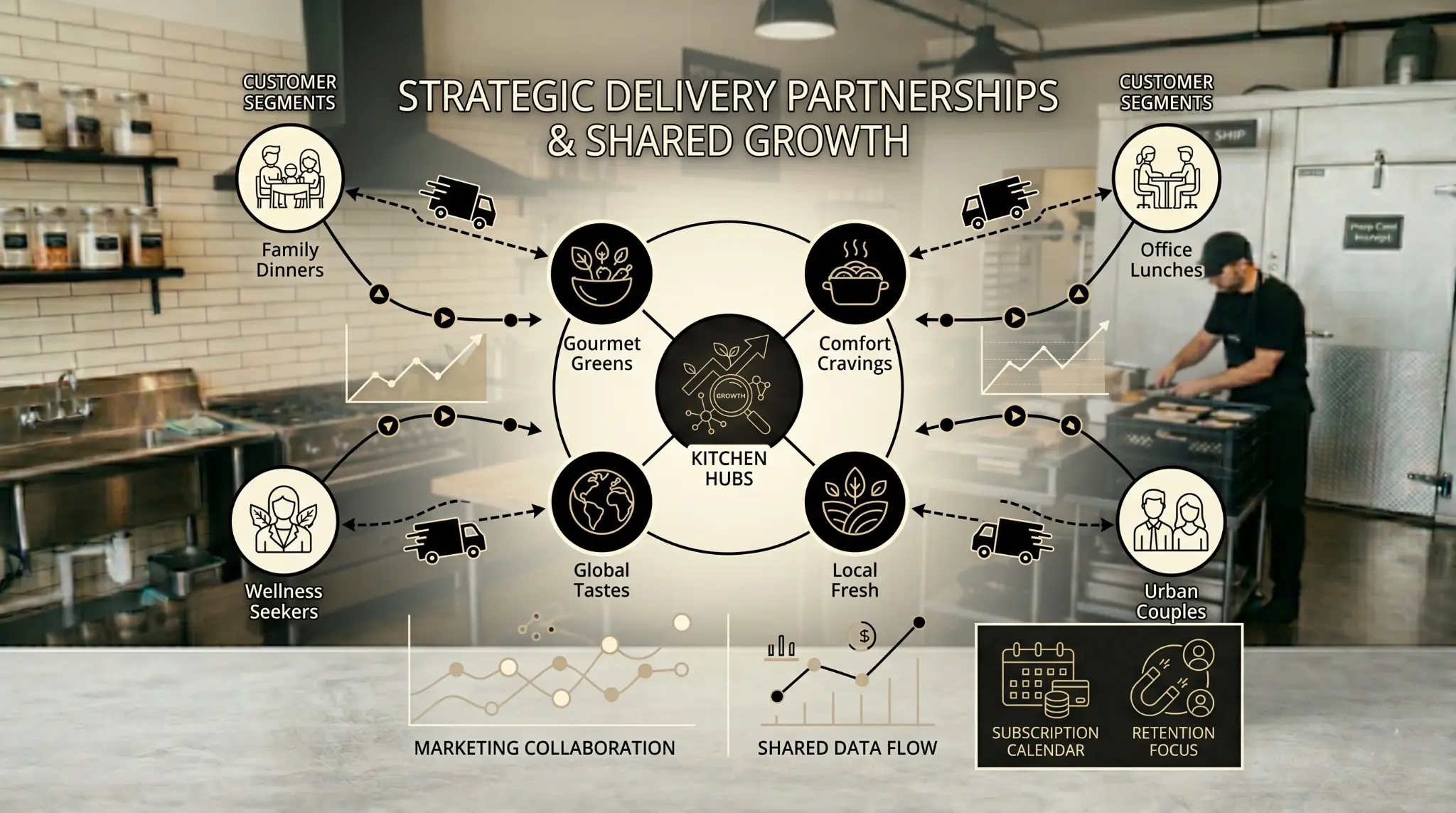
Delivery partnerships are strategic collaborations between companies that share overlapping audiences or operational goals. This can include restaurants, ghost kitchen brands, technology providers, or consumer brands targeting similar customer segments.
Examples include cross-promotions between a bakery and a specialty coffee brand, integration with ordering platforms, or joint campaigns among multiple food brands in a local area.
These partnerships allow each participant to access a pre-established audience, creating exposure that would be more expensive or slower to achieve independently.
Over time, these collaborations can turn customer acquisition into a shared process, where every partner contributes distribution, credibility, and marketing support.
Understanding CAC in the Delivery Model
Customer Acquisition Cost (CAC) measures the total investment required to acquire a new paying customer, including marketing, promotions, and tools used to convert leads.
In delivery, CAC can rise quickly due to competitive bidding for ad space, high platform commissions, and promotional costs.
Relying exclusively on paid channels makes CAC sensitive to algorithm changes and bidding pressures.
By understanding CAC and how it behaves in your market, you can better evaluate alternative acquisition strategies, including partnerships that share the effort and reduce reliance on costly advertising.
Read more: Here’s How to Master Your Restaurant Marketing Strategy
Why Strategic Partnerships Reduce CAC
Partnerships lower CAC by replacing cold outreach with introductions to warm, qualified audiences. Key benefits include:
- Shared marketing responsibilities: Partners distribute campaigns and exposure across multiple channels.
- Access to pre-qualified audiences: Customers already interested in related products are more likely to engage.
- Higher-intent traffic: Leads from partners often convert faster, reducing wasted spend.
According to marketing research, co‑marketing partnerships often deliver significantly lower customer acquisition costs than traditional paid advertising, as they allow businesses to split marketing expenses and tap into partners’ established audiences.
In some cases, partner channels have delivered acquisition costs ranging from $75 to $200 per customer, compared with $200–$500 or more for paid search, display, and event marketing
Top Strategic Partnership Types That Reduce CAC in Delivery
Different types of partnerships can be applied depending on your brand goals, audience, and operational setup. These strategies have proven effective for reducing acquisition costs and accelerating growth.
Cross-Promotion with Complementary Brands
Cross-promotion involves two brands with complementary audiences promoting each other through existing channels.
For instance, a bakery delivery brand might collaborate with a local coffee roaster, featuring each other in social media, email campaigns, or bundled offers.
This approach drives visibility for both partners, engages audiences already interested in similar products, and often results in higher conversion rates than traditional cold advertising.
Over time, consistent cross-promotion contributes to mutual audience growth, continuously introducing new customers to each brand.
Referral and Affiliate Programs in Delivery
Referral programs encourage customers, influencers, or local businesses to introduce your brand to new audiences.
Common models include customer discounts, influencer partnerships, affiliate links, or in-app referral incentives.
Because referrals rely on trust and personal recommendations, they tend to convert more efficiently and reduce overall acquisition costs.
For delivery operators, structured referral programs can amplify reach while strengthening community-based growth and engagement.
Co-Marketing and Joint Campaign Launches
Co-marketing campaigns involve two or more brands collaborating on a single initiative, such as seasonal menu launches, neighborhood promotions, or joint product releases.
By sharing costs and audiences, partners amplify visibility without paying for each impression independently.
Co-marketing is particularly effective for delivery brands entering new areas, as it accelerates awareness while creating long-term partnership opportunities that can continue generating demand beyond the initial campaign.
How to Measure CAC Reduction from Partnerships
Tracking and evaluating partnerships is essential to understand their impact on acquisition efficiency.
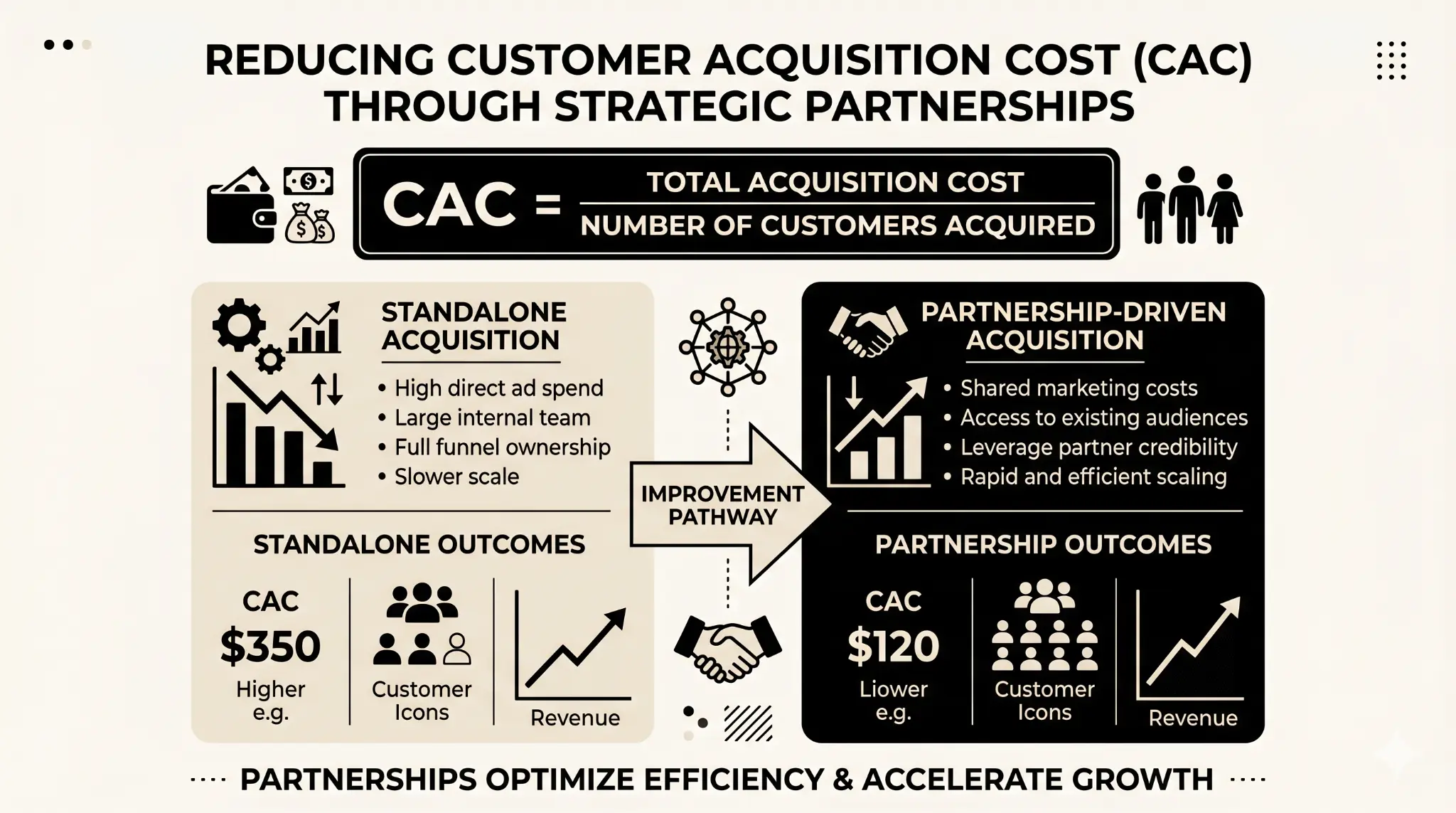
CAC Before and After Partnership Activation
Start by comparing CAC before and after a partnership begins.
Use the standard formula:
CAC = Total acquisition cost ÷ number of new customers acquired
Measuring baseline CAC across traditional channels versus partner-sourced acquisition allows you to determine how much partnerships contribute to efficiency gains.
Key Metrics Beyond CAC
CAC alone does not capture the full performance of partnerships. Additional metrics to track include:
- Customer Lifetime Value (LTV): Total revenue a customer generates over time.
- Conversion Rate: How effectively partner traffic converts into paying customers.
- Retention Rate: Whether partner-acquired customers continue ordering.
- Payback Period: How long it takes to recover acquisition costs through revenue.
Monitoring these metrics provides insight into both short-term efficiency and long-term profitability from partnerships.
Building a Simple Partnership Performance Dashboard
A dashboard consolidates key metrics like partner traffic, CAC per partner, conversion rates, and repeat purchase behavior. This makes it easier to identify which partnerships deliver the strongest results and inform future marketing investments.
Real-World Delivery Application Scenarios
Practical examples show how strategic partnerships can lower CAC while creating lasting growth.
Technology Integration Partnership Example
Integrating your delivery system with restaurant management software or POS platforms can turn a technology partner into a distribution channel. As restaurants adopt the platform, they gain exposure to your service, introducing new customers organically.
Loyalty and Delivery Ecosystem Strategy
Shared loyalty programs across multiple brands encourage repeat purchases and improve customer lifetime value. Because multiple partners contribute, marketing costs and reward distribution are shared, making campaigns more efficient and scalable.
Local Launch Co-Marketing Example
Entering a new neighborhood can be expensive due to low initial awareness. Partnering with local cafés, grocery stores, or lifestyle brands for promotions expands reach and builds community awareness while distributing marketing effort.
Co-marketing campaigns may include bundled offers, social media promotion, or shared discounts to attract attention without excessive ad spend.
Make Partnerships Your Competitive Edge in Delivery
Delivery growth becomes more sustainable when you don’t rely entirely on advertising budgets.
Strategic collaborations, co-marketing campaigns, and technology integrations allow brands to reduce acquisition costs, build credibility, and strengthen customer relationships.
By tracking CAC and related metrics before and after partnerships, you can validate effectiveness and ensure long-term scalability.
If you're ready to transform delivery partnerships into a measurable competitive advantage, explore CloudKitchens and schedule a tour of our private kitchen locations.
Our operational ecosystem is designed to support multi-brand collaboration, co-marketing campaigns, and integrated delivery strategies, helping you scale efficiently while optimizing customer acquisition costs.
DISCLAIMER: This information is provided for general informational purposes only and the content does not constitute an endorsement. CloudKitchens does not warrant the accuracy or completeness of any information, text, images/graphics, links, or other content contained within the blog content. We recommend that you consult with financial, legal, and business professionals for advice specific to your situation.