Smart, efficient and sustainable ways to boost production capacity without the cost of new hires.
Food production efficiency is the most sustainable way to grow your business without the overhead of a larger workforce. A focus on process optimization, smart automation, and workflow efficiency unlocks hidden capacity within existing operations.
Greater operational discipline makes it possible to absorb rising demand while maintaining quality standards and protecting profit margins.
Scaling your business doesn't always mean hiring more hands; it means making the hands you have more effective. Through strategic planning and the right tools, you can transform a traditional kitchen into a high-output facility.
This guide explores how to refine your systems to achieve scaling food business output without the complexity of managing a massive team.
Build a Lean Production System That Scales
Implementing a lean system is the first step toward scaling your food business output without increasing your payroll.
Lean principles focus on identifying and removing any activity that does not add value to the final product. By refining these internal processes, you create a foundation that can handle higher volumes with the same amount of effort.
Eliminate Waste with Lean Principles
Applying lean production standards in the food industry requires a close analysis of daily routines to identify where time and materials are being lost.
Identifying bottlenecks, such as a slow cooling process or a manual packing station, makes it possible to reallocate resources and keep the line moving. A consistent focus on flow ensures the team spends more time producing and less time waiting for the next step.
According to Mordor Intelligence, the global food processing automation market was valued at approximately USD 27.95 billion in 2025, reflecting strong demand for automation solutions that increase output, improve efficiency, and help manage labor constraints.
Standardize and Document Every Step
Creating robust standard operating procedures (SOPs) is vital for maintaining consistency as you increase your production volume.
When every task is documented, training becomes faster and errors decrease, which directly impacts your overall food production efficiency. Clear documentation allows your current team to work with precision, reducing the need for constant supervision or rework.
Use Agile Thinking for Continuous Improvement
Agile thinking encourages your team to use feedback loops and KPIs to make small, frequent improvements to the production line.
Instead of waiting for a major overhaul, you can iterate on food production optimization strategies every week to find marginal gains. This culture of continuous improvement empowers your staff to suggest changes that make their own jobs more efficient.
Increase Output with Smart Technology & Automation
Integrating kitchen automation technology is one of the most effective ways to scale food production without hiring additional staff. Automation handles repetitive, physically demanding tasks that often slow down teams and lead to fatigue-related errors.
By letting machines handle the heavy lifting, your team can focus on quality control and higher-level management.
Automate Repetitive, Low-Value Tasks
Starting your food production automation journey often begins with tasks like portioning, labeling, or heavy mixing.
These repetitive actions are where human error is most common and where speed is often limited by physical constraints.
Automating these specific points allows you to maintain a steady pace that is impossible to achieve through manual labor alone.
The same Mordor Intelligence study also emphasizes that smart and AI-enabled systems are the fastest-growing segment of the global food processing machinery market, driven by demand for higher efficiency, reduced labor costs, and improved consistency in production.
Use Real-Time Monitoring & Predictive Maintenance
Using predictive maintenance strategies for food equipment ensures that your machinery stays operational when you need it most.
Real-time monitoring sensors can alert you to potential failures before they happen, preventing costly unplanned downtime that halts your production. This proactive approach keeps your food production efficiency high by ensuring your tools are always ready for the next batch.
Invest in Modular, Flexible Equipment
Modular equipment allows you to adapt your production line as your product mix changes without needing a full facility redesign.
This flexibility is a cornerstone of efficient kitchen workflow in scaled production, as it allows for quick transitions between different types of food items.
Choosing versatile machinery means you can scale different product lines using the same footprint and the same team.
Optimize Workflow & Facility Layout for Maximum Throughput
The physical arrangement of your production space has a massive impact on your workflow efficiency and total output. Even the most advanced equipment will underperform if the layout forces workers to move unnecessarily or cross paths constantly.
A well-designed floor plan minimizes "travel time" and keeps the focus on the actual transformation of ingredients into finished goods.
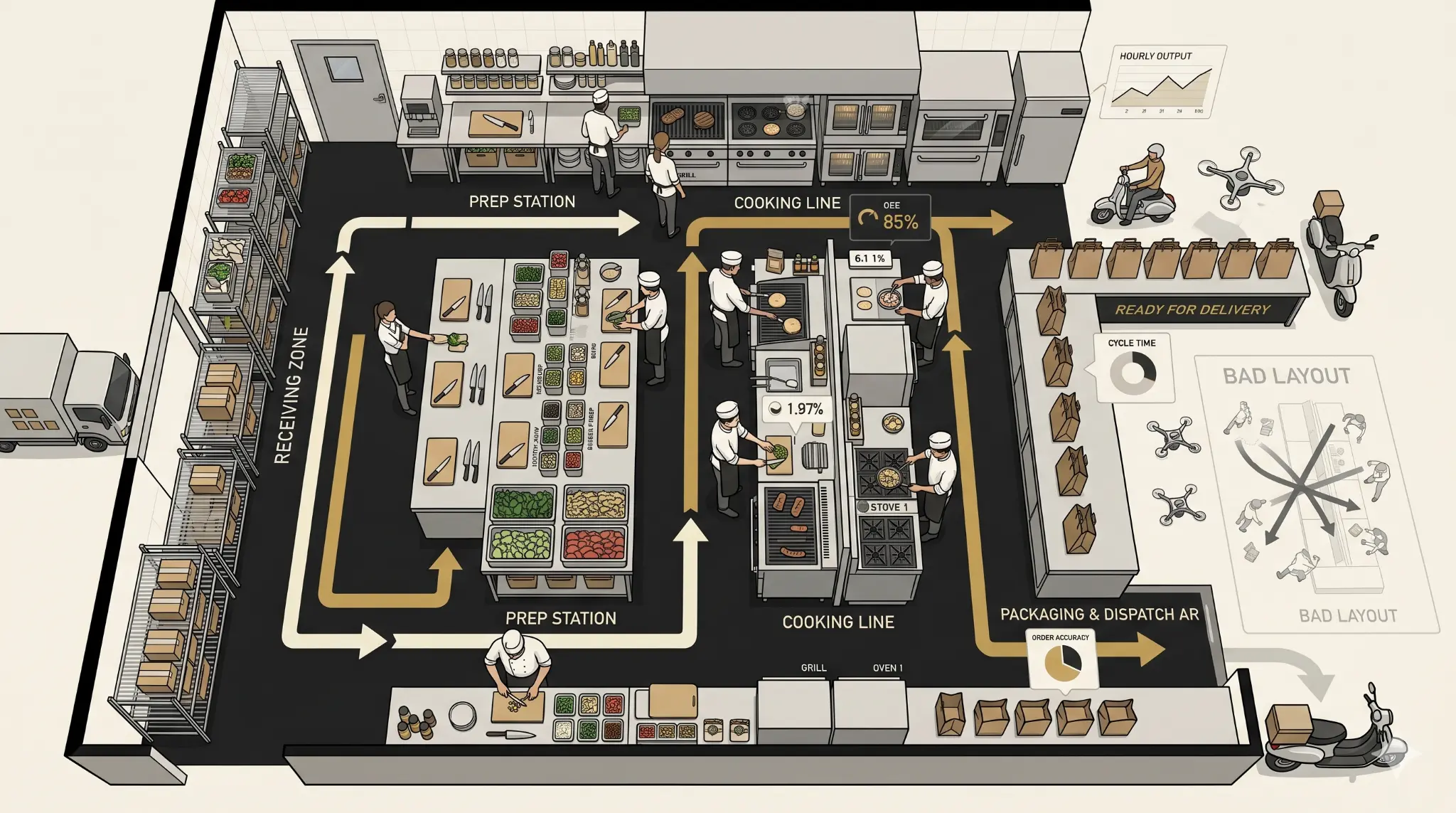
Zone Your Kitchen or Production Floor
Zoning your facility involves creating dedicated areas for receiving, prep, cooking, and packaging to prevent cross-traffic and confusion.
Clear organization is critical to efficient kitchen workflow in large-scale production, allowing team members to specialize in their stations.
When everyone knows exactly where they need to be, the entire production process moves with much greater speed and safety.
Read more: Multi-Brand Operations: Maximizing Revenue Streams from a Single Kitchen Hub
Place Equipment to Minimize Movement
Reducing the distance between workstations can shave seconds off every task, which adds up to hours of saved labor every week. By placing high-use tools and ingredients within arm's reach, you optimize the food production efficiency of every individual on your team.
This "point-of-use" storage strategy ensures that your staff spends more time producing and less time walking across the floor.
Track the Right KPIs (OEE, Throughput, Cycle Time)
You can’t improve what you don’t measure, so tracking batch processing optimization through KPIs is essential for growth.
Metrics like Overall Equipment Effectiveness (OEE) and cycle time show where production is lagging and where capacity can be unlocked. These insights help you apply optimization strategies with the highest return.
High-performing manufacturers rely on OEE and throughput data to increase output without adding labor. Regular performance reviews keep teams aligned and focused on efficiency gains.
Scaling your food production is a journey of refinement rather than just expansion. By focusing on food production efficiency through lean systems, smart technology, and optimized layouts, you can grow your business sustainably.
Ready to increase your food production without growing your team? Discover how CloudKitchens’ ready-to-run kitchen spaces help you scale faster and smarter. Explore our locations and schedule a tour to find the right kitchen for your next move.
DISCLAIMER: This information is provided for general informational purposes only and the content does not constitute an endorsement. CloudKitchens does not warrant the accuracy or completeness of any information, text, images/graphics, links, or other content contained within the blog content. We recommend that you consult with financial, legal, and business professionals for advice specific to your situation.