An actionable roadmap to launch faster, reduce overhead, and scale inside delivery-ready professional kitchens.
Launching a meal prep brand requires more than strong recipes and appealing photos. Founders need a structured plan that considers compliance, workflow, pricing, and long-term scalability.
For entrepreneurs researching how to start a meal prep business, one of the most important decisions is where production will happen. The right kitchen environment affects licensing, food safety compliance, operational efficiency, and growth potential.
This guide presents a practical roadmap for building a meal prep business startup inside a professional kitchen.
You will learn how to define your concept, structure your meal prep business plan, navigate food business licensing, optimize kitchen operations, and prepare for sustainable expansion.
Why a Professional Kitchen Is the Smart Starting Point
Before designing menus or launching marketing campaigns, founders must choose their production structure.
The difference between operating from a residential setup and a licensed commercial facility has direct implications for compliance, credibility, and scalability.
A professional kitchen aligns your operation with regulatory standards and supports delivery-first business models from the beginning.
Legal compliance & health codes
Most jurisdictions require prepared food to be produced in a licensed commercial kitchen. Health departments typically mandate inspections, sanitation protocols, temperature controls, and documented food safety procedures.
Operating inside a compliant facility simplifies food safety compliance and supports adherence to kitchen licensing requirements.
The infrastructure is already aligned with regulatory expectations, which reduces uncertainty during inspections and creates operational stability.
While specific food business licensing requirements vary by city and state, producing meals inside a regulated environment positions your meal prep delivery service for long-term sustainability.
Commercial vs shared kitchen spaces
Entrepreneurs entering commercial kitchen meal prep often evaluate different facility models.
A commissary kitchen for rent or shared kitchen may provide scheduled access to production space and equipment. This structure can work well during early stages, although time blocks and shared infrastructure may require strict coordination.
A private ghost kitchen model offers dedicated space built for off-premise brands. Instead of rotating schedules, operators manage their own production flow and storage.
This structure supports consistency, especially for a meal prep subscription service that relies on predictable weekly output.
What a delivery-optimized kitchen offers
A delivery-optimized kitchen is designed around efficiency. Layouts support batch cooking, portioning, labeling, and order staging in a logical sequence.
This environment improves meal prep workflow and helps reduce unnecessary movement within the space. It also supports scaling volume over time, which is essential for a healthy meal prep business focused on recurring subscription meal plans.
Step 1: Define Your Target Market & Meal Prep Concept
Every successful meal prep business startup begins with clarity about who the business serves and what problem it solves. Without a defined audience, pricing and marketing strategies become inconsistent.
This stage shapes your menu, branding, packaging, and overall positioning.
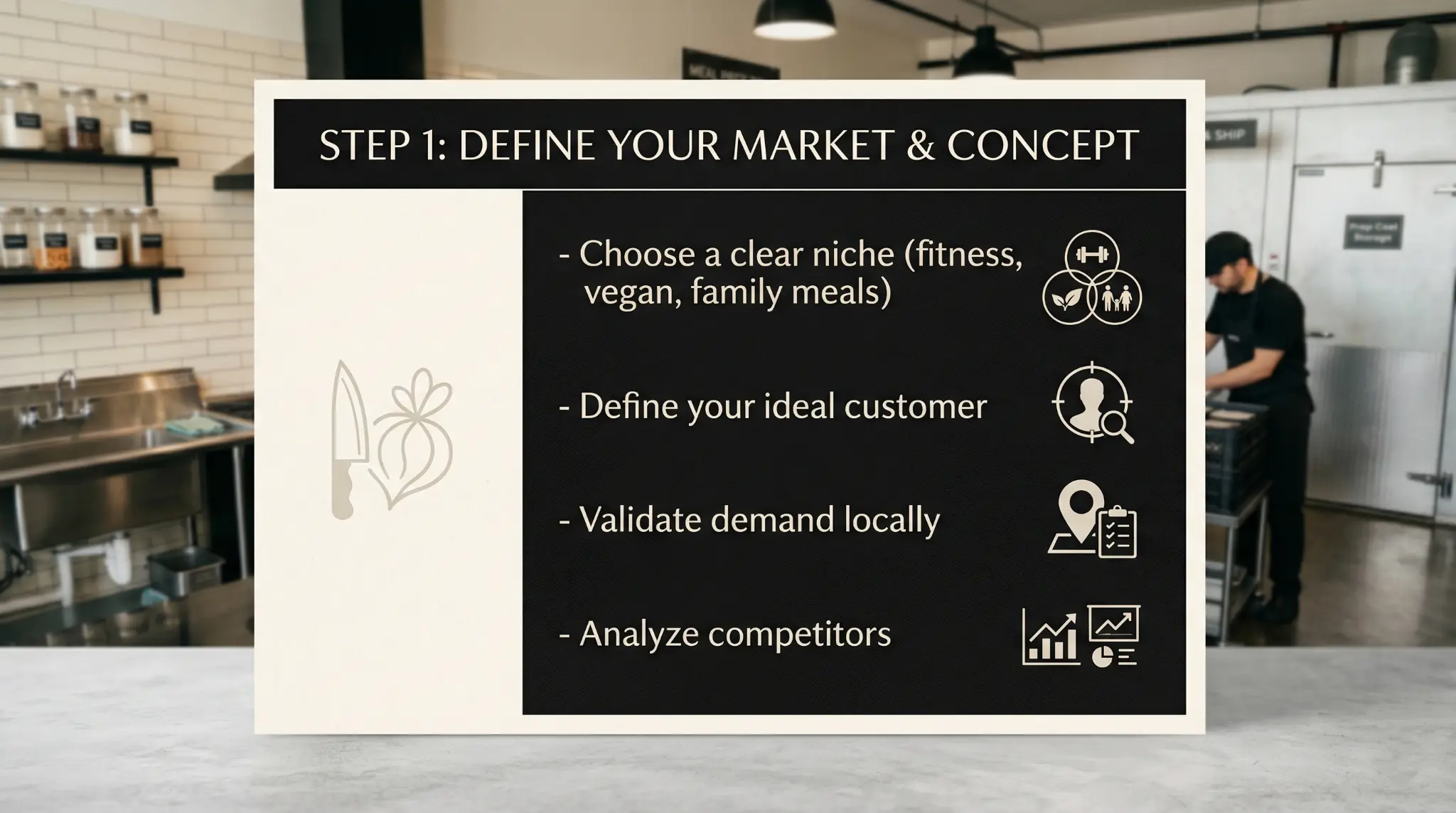
Choose your niche
Instead of offering a broad menu, define a specific focus. Some businesses concentrate on fitness-oriented meals, while others target busy families, low-carb consumers, plant-based audiences, or corporate clients.
Your niche determines portion sizes, ingredient sourcing, and menu structure. It also influences your brand voice and marketing channels. Clear specialization strengthens differentiation in competitive markets.
Customer persona & demand mapping
Understanding your ideal customer requires more than assumptions. Consider lifestyle, income range, dietary preferences, and buying behavior.
Review delivery apps and local competitors to identify existing subscription meal plans and gaps in the market. Evaluate customer reviews to understand recurring complaints or unmet needs.
This validation process is a critical step in learning how to start a meal prep business strategically rather than reactively.
Competitive analysis
A structured competitive review provides practical insights. Study local meal prep delivery service providers and analyze their pricing models, subscription flexibility, portion sizes, and delivery zones.
Observe how competitors position themselves online and what messaging resonates with customers. This information strengthens your meal prep business plan and reduces guesswork during launch.
Step 2: Plan Your Business & Financials
A clear financial framework transforms an idea into a viable operation. Without defined margins and projections, scaling becomes unpredictable.
This step ensures your business model supports profitability and operational sustainability.
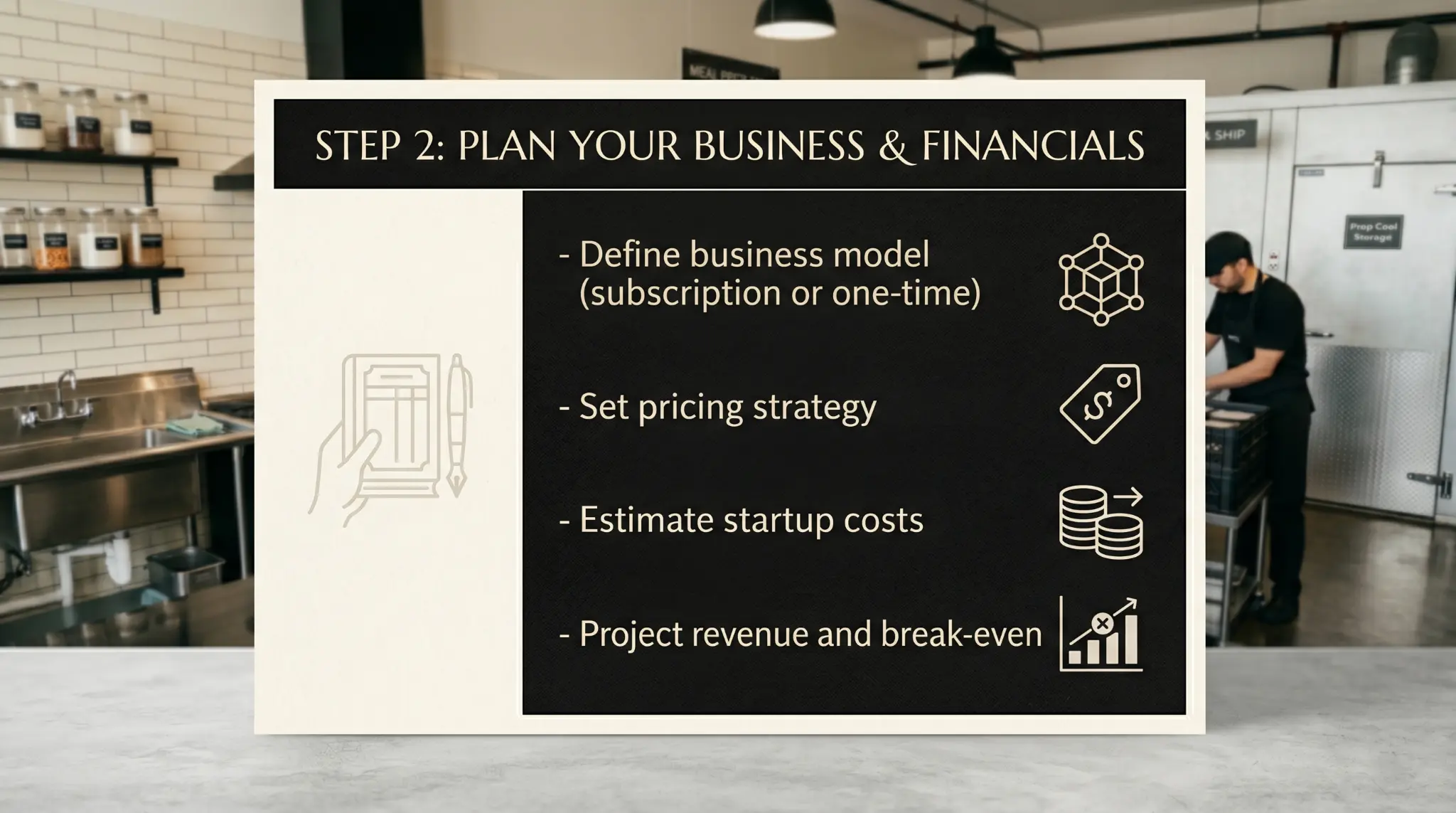
Business model & pricing strategy
Meal prep companies typically generate revenue through weekly orders, structured subscription plans, or corporate contracts.
A meal prep subscription service often provides more predictable cash flow, while one-time orders may support broader reach.
Meal prep pricing strategies must account for ingredient costs, labor, packaging, kitchen fees, delivery expenses, and food business insurance. Pricing should reflect perceived value while protecting margins.
Consistency in pricing logic strengthens customer trust and financial planning.
Startup costs
Startup investment varies widely by location, scale, and chosen facility model. According to the EatFresh Tech Startup Guide, entrepreneurs can begin a meal prep business with a modest budget, potentially as low as around US $1,000 if testing concepts from home, or closer to US $15,000 or more when renting commercial kitchen space and covering licensing, ingredients, equipment, and packaging upfront.
Another industry resource suggests that planning a US $5,000 to US $15,000 initial investment for basic costs such as kitchen rental, equipment, ingredients, and marketing reflects common expectations for a delivery-focused meal prep startup.
Operating inside a professional kitchen can reduce construction or build-out costs compared to traditional restaurant setups while aligning with food safety compliance and delivery optimization needs.
Revenue projections & break-even
Revenue projections begin with estimating average order value and weekly customer volume. From there, calculate fixed monthly expenses and variable cost per meal.
Determining contribution margin helps identify the number of subscriptions required to reach break-even. This structured approach supports informed scaling decisions and reduces financial uncertainty.
Step 3: Licenses & Compliance (Food Safety First)
Regulatory compliance is foundational when exploring how to start a meal prep business. It protects both the business and its customers.
Ignoring compliance can lead to operational disruptions and reputational damage.
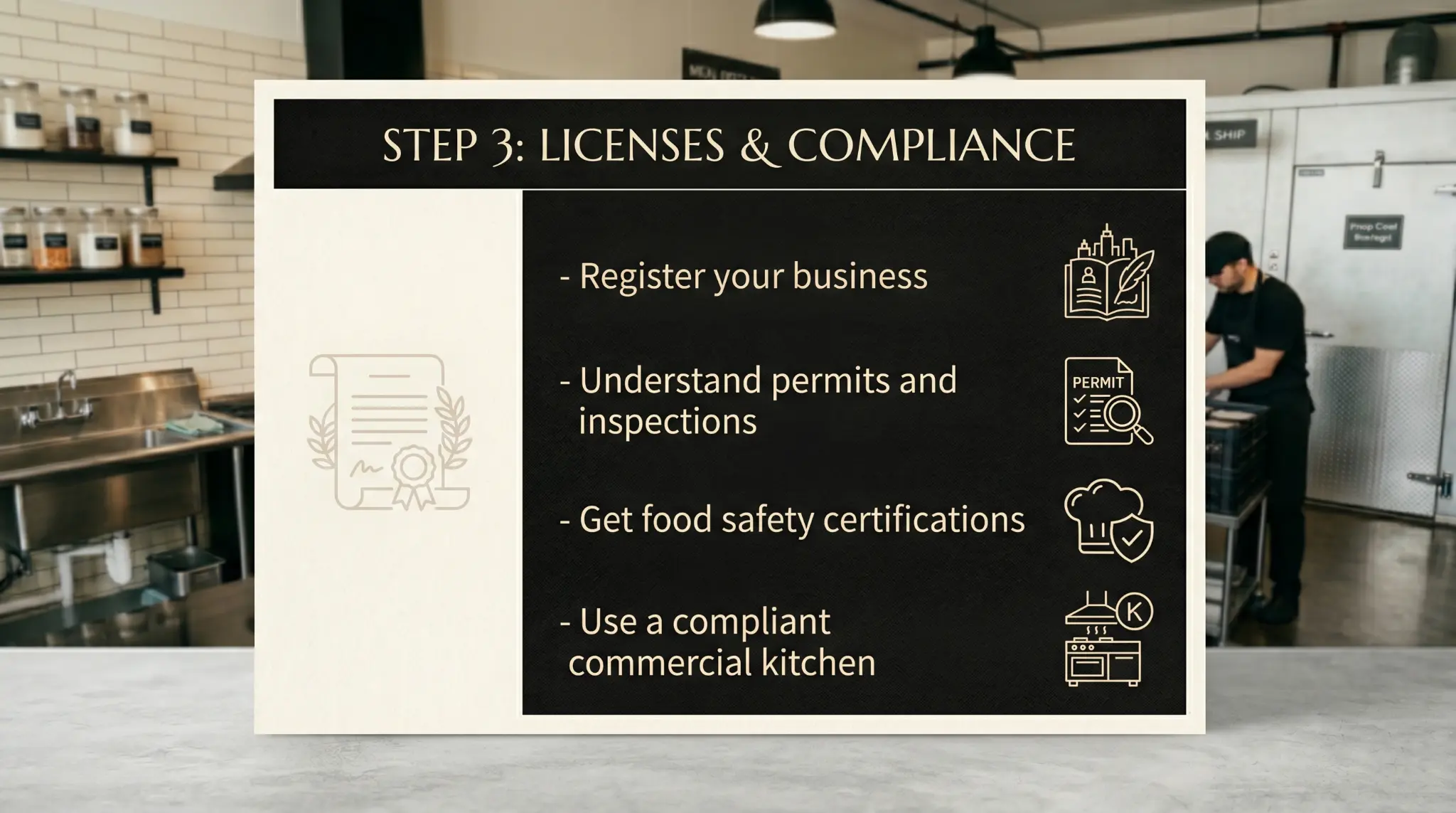
Permits & inspections
Most meal prep businesses require a general business license and approval from the local health department. Inspections typically review sanitation procedures, temperature controls, and facility standards.
Producing inside a licensed commercial kitchen simplifies this process because the infrastructure aligns with regulatory expectations. Always confirm specific food business licensing requirements with local authorities.
Food safety training & certifications
Many regions require at least one certified food protection manager. Programs such as ServSafe are commonly recognized in the United States.
Documented training, safe handling procedures, and clear labeling protocols strengthen food safety compliance and demonstrate professionalism.
Commercial kitchen requirements
A compliant commercial kitchen includes proper ventilation, refrigeration capacity, designated prep zones, and sanitation infrastructure.
Meeting these standards supports consistent quality and aligns your business with regulatory frameworks.
Step 4: Kitchen Setup & Operations
After securing licensing and space, operational systems determine efficiency. Structured production reduces waste and supports consistent output.
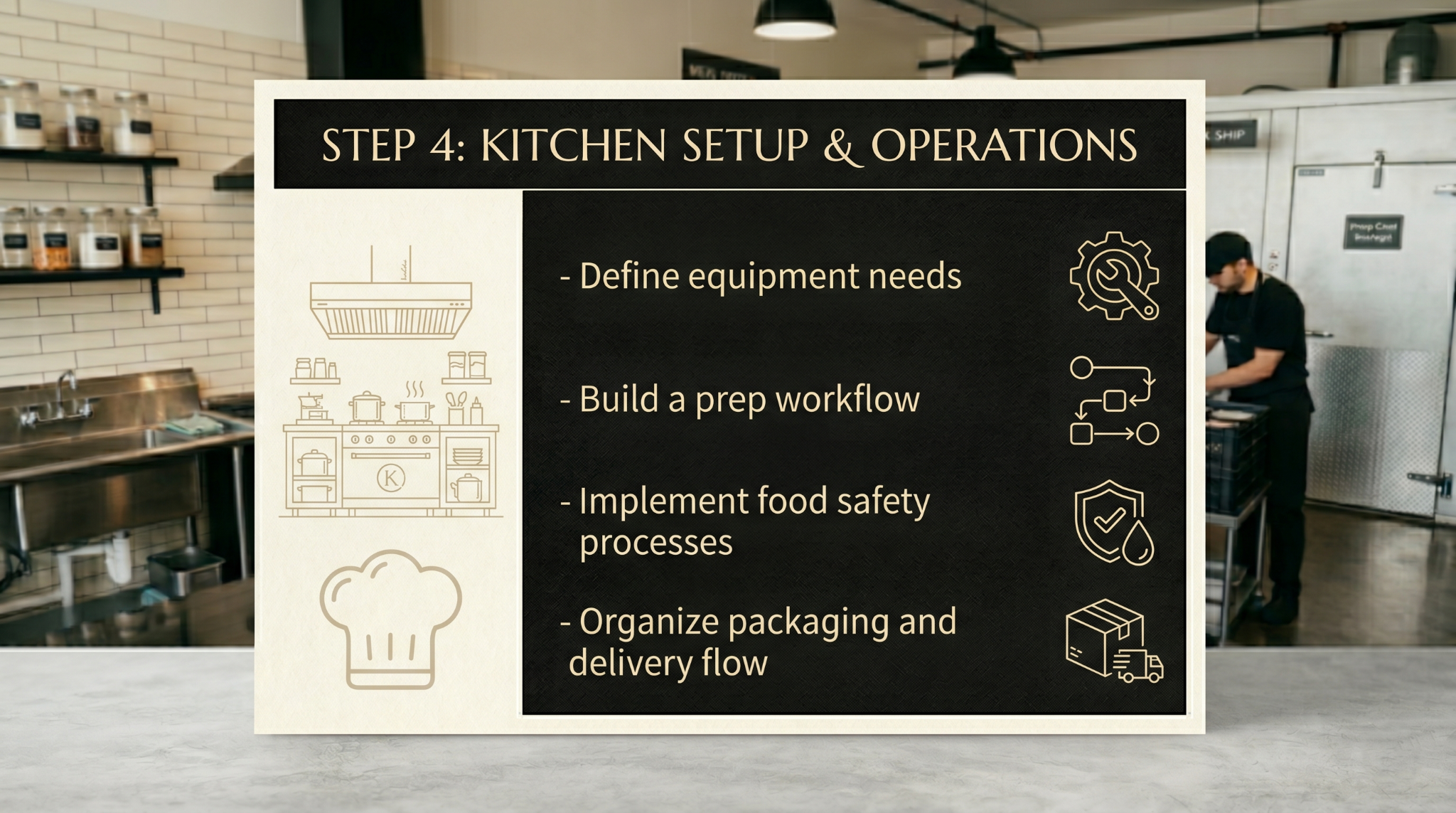
Essential equipment considerations
Equipment needs depend on your menu and scale. Most commercial kitchen meal prep operations rely on prep tables, refrigeration units, cooking equipment, portioning tools, and labeling systems.
Evaluating equipment early ensures that production capacity aligns with projected demand.
Workflow & food safety protocols
A structured meal prep workflow typically follows a clear sequence: ingredient receiving, batch cooking, cooling, portioning, labeling, and staging for delivery.
Written protocols reduce confusion and support team coordination. Clear processes also strengthen food safety compliance and maintain product consistency.
Delivery workflows & packaging
Packaging influences customer perception and food integrity. Meal prep packaging solutions should preserve freshness and prevent contamination during transport.
A reliable meal prep delivery service requires defined order cutoffs, staging areas, and integration with delivery platforms. Consistency in logistics strengthens retention and repeat purchases.
Step 5: Marketing, Launch & Growth
Operational readiness must be matched with a clear customer acquisition strategy. Marketing supports visibility, while retention supports profitability.
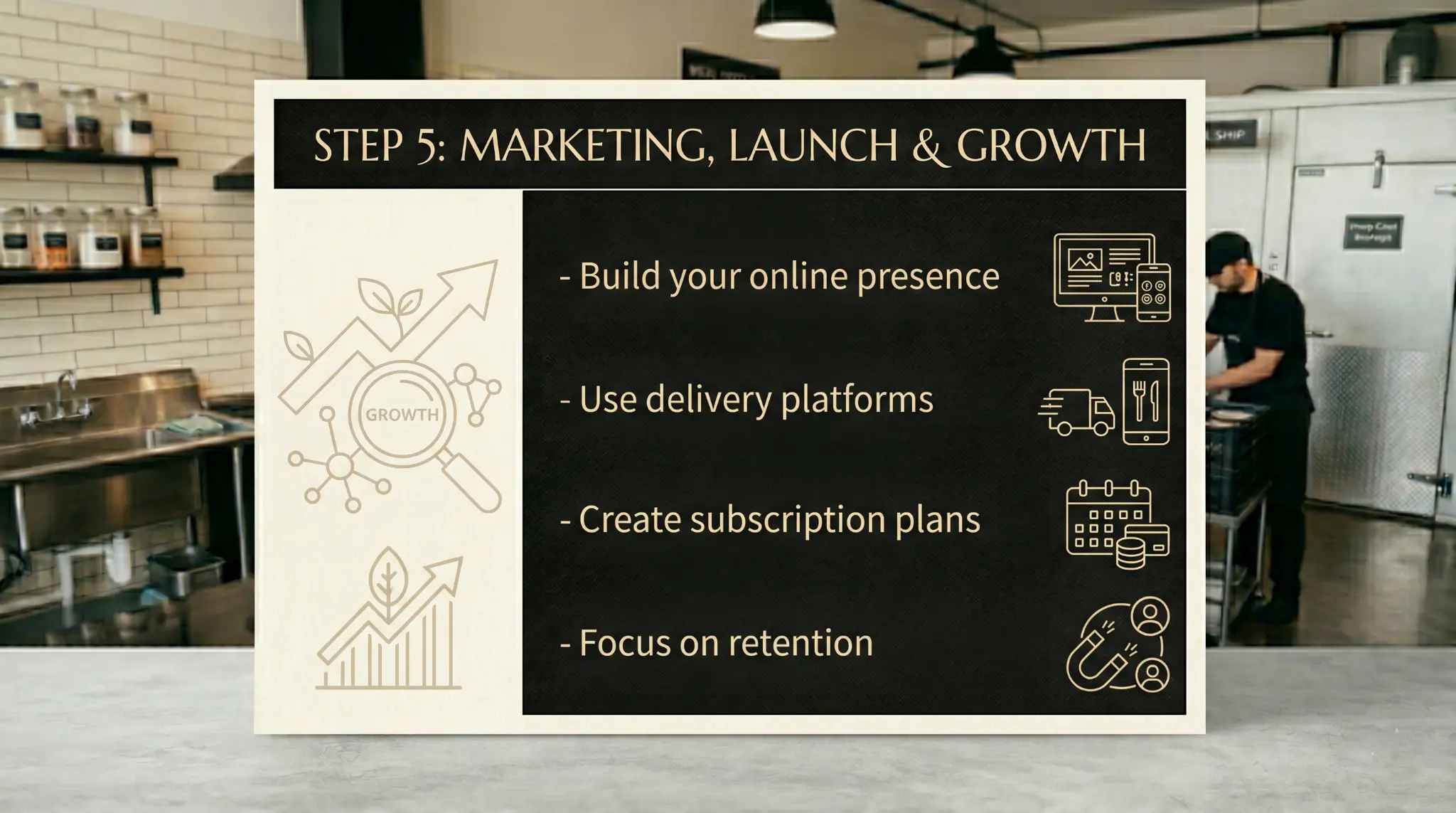
Brand positioning & online presence
A clear website should outline your niche, menu, pricing structure, and subscription options. Transparent messaging builds credibility.
Customer testimonials and clear nutritional information support trust and brand authority.
Delivery platforms & integrations
Many founders use third-party platforms to increase early visibility. Others prioritize direct subscriptions to strengthen margins.
A delivery-optimized kitchen supports both strategies and allows gradual channel diversification.
Retention & recurring revenue
Recurring revenue stabilizes cash flow and improves forecasting. Structured subscription meal plans, loyalty incentives, and referral programs encourage long-term engagement.
Consistent quality and reliable delivery are central to retention.
Common Mistakes & Pro Tips
Understanding common pitfalls reduces unnecessary risk in a meal prep business startup.
Underpricing your meals
Underestimating ingredient inflation, packaging, and overhead can weaken margins. Pricing should reflect true production costs and support reinvestment.
Ignoring compliance & food safety
Overlooking certifications, inspections, or food business insurance increases operational risk. Proactive compliance protects credibility and continuity.
Skipping market validation
Launching without confirming demand may result in inconsistent orders or excess inventory. Validating your niche and pricing before scaling improves stability.
Your Next Move Starts in the Right Kitchen
Learning how to start a meal prep business involves more than creating appealing menus. The production environment directly influences compliance, workflow efficiency, and scalability.
Operating inside a professional, delivery-focused kitchen supports structured growth without the complexity of a traditional restaurant build-out.
CloudKitchens provides private professional kitchen spaces located in high-demand areas and designed for off-premise brands.
Explore CloudKitchens locations and choose the kitchen that fits your growth plan.
DISCLAIMER: This information is provided for general informational purposes only and the content does not constitute an endorsement. CloudKitchens does not warrant the accuracy or completeness of any information, text, images/graphics, links, or other content contained within the blog content. We recommend that you consult with financial, legal, and business professionals for advice specific to your situation.